Tag: upyerbrum

Quality newspaper video from the Birmingham Mail:

[youtube:http://uk.youtube.com/watch?v=ZiFZtI_KLXQ]

Why do I like this?

Static shots well framed with thought for the lighting. Simple story, well told by one voice, someone we can relate to. No poor voice over from someone who didn’t get into the BBC because they couldn’t broadcast and equally no tacky script riddled with newspaper cliches, the sort of things no one would ever say.  Timeless. Finally it gives the pictures a little room to breathe.

So, Birmingham Mail, very well done.

Update:  from a comment below (source verified) this wasn’t made by the Birmingham Mail, but provided for them by MG.  The Mail has put it up on their youtube channel without telling us that this is provided by a pr company.  They haven’t even used the text beside the video to clarify things. Why would a newspaper be so careless about the boundary between what pr people do and what journalists do?

So, Birmingham Mail, very poor.

CarrotMob or Save the environment by drinking beer.

There are different ways to tackle climate change. In the last month I’ve written about the focussed and globally ambitious cquestrate. Now recent Birmingham Blogger Jonathan Melhuish (and also here) who’s relocated to London tells me you can also do it by drinking beer.

Carrot Mobs work by finding the local business which is willing to devote the largest portion of an half days takings to green upgrades. When a store commits to divert the dosh into making changes you organise to provide as many customers as possible in that afternoon

CarrotMob is a fun community action which rewards businesses that become more energy efficient. The concept is to take several businesses in a community and start a bidding war find the one prepared to invest the most in improving their energy efficiency. We then all flashmob the winning business at the agreed time and make our purchases there. The business then spends the agreed percentage of revenue it took during the CarrotMob on replacing appliances with more energy-efficient models. Everybody wins! 🙂

[youtube:http://uk.youtube.com/watch?v=LUz0kM1u_jk&e]

It sounds fun and makes a huge amount of sense for each business. Fan Page.

The fab moment Lucy Moore realised her Grandfather’s picture was The Big Picture Winner 2008

[youtube:http://uk.youtube.com/watch?v=Aef5QhThEqQ]

I love this video – keep watching until the end. It shows just how much emotion was invested in The Big Picture – the West Midland’s Guinness World Record breaking photographic art event. One of eight photographs had been chosen as the picture to be used for the World’s Biggest photo Mosaic which was unveiled this lunchtime at Millennium Point in Birmingham. The digital Mosaic can be found here on the site and is worth a zoom in! Some of my pictures are in there – yours might be too – and we’re all joint world record holders!

One thing that made me realise that it had introduced new people to the regional arts world was a simple comment at the unveiling. “Who are all these people, I’ve not seen most of them before” very a very experienced regional arts bod. That is the whole point, to get beyond the usual.
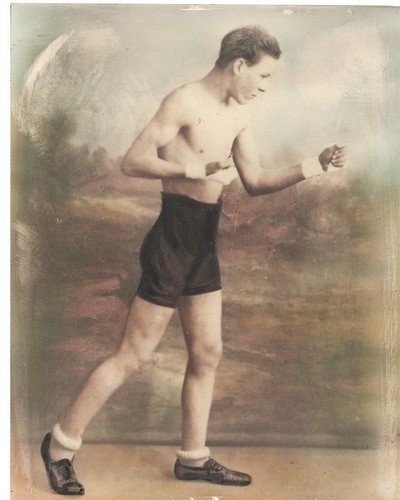
So what of the winning photo Lucy Moore submitted:

Big Picture Winner 2008

As the blurb on flickr says:

Seventeen year old, Tipton born Lucy Moore sent in this picture of her Grandfather, who holds a very special place in her family’s heart after dying in 1987. The family believes the picture was taken around 1926, when her Grandfather, the late Arthur James Bunce was seventeen and an amateur boxer. So powerful is the image, that Lucy’s brother has had it tattooed across his back as a lasting tribute to Arthur.

Congratulations to everyone who took part, including Arts Council West Midlands, Audiences Central, BBC West Midlands and artist Helen Marshall, Then there are others who worked on it: Jon Bounds, Stef, Mark, Chris, Kerry, Lucy, Kate… Plus of course those who also added pictures, like Paul and Elizabeth, Steve, Hanuman, Pete, Pete MCJ, Rebecca, Richard, Paul, Lee…and hundreds/thousands of others.

Groundwork UK, twitter and how about a map for funding applications?

groundworktwitter1.jpg

The image above is some of the feedback from asking my friends on twitter how Groundwork might use the service.   The group I was working with were a little surprised (“wow”) by the speed and quality of the input from a network tool like this – so to Laura, Michael, Jon, Dave, Alice, Katie, Paul and Charlotte thank you – even amongst your number there was evident support and affection for the major national community and environmental charity.

The session was a general get-the-juices-flowing-see-whats-possible-start-to-get-your-head-around-whats-out-there 90 mins and to that end I think the one clear factor that emerged was that a bit of rss is needed in Groundwork towers.
The group I was working with manage grants for one of the projects and have to record and evaluate what’s being achieved, so the possibilities of digital media in terms of capturing what happens and starting a conversation about applications etc are self evident.

The conversation that really aroused my interest though hapened at the end once most people had floated away.

What if you use something like google maps to publicly share every single application you get?  You put all of them on the web and tie them to a map.  Green for approved red for rejected.  How will this change the dynamic betwen the grant givers and the apl;licants?  Will such transparency improve the system or weaken it?

It got me thinking about social media and market forces.  My A Level economics teacher frequently told me that a perfect market means everyone has perfect information.  Imagine a market for funding bids where everyone who is applying knows about every aplication that has happened, where they took place, whether they were approved and if not why not.   Could that improve efficiency in the distribution of grants?

The folk in East Anglia might understand that their area is already saturated with approved grants – so seek support from another fund or change their plans.  Groups in Northumberland might see there’s a real opportuntiy because their patch is under represented. Those who write the applications can see exactly what others have been saying so it will give them a realistic level of confidence in their ideas.  Those who hand out the grants can be more easily held to account – or better still the minds of the public can be put to helping them constantly refine and improve their decision making.

Sit around it a conversation about the rights and wrongs of particular grant applications and you can begin (with careful nurturing of the online community) to crowdsource a sense of where people want to see their money being spent.

Now don’t expect Groundwork to do this tomorrow – or even at all.  It is a big cultural leap for any organisation and it may not be that useful or warrant the effort.  This was simply one of those conversations that went deep down into the possibilities and cultural impact of social media.  But I share it as an idea. What do you think?