Category: Citizen Journalism

A Comment on the Digital Britain Interim Report

To find the Digital Britain interim report click on this image

Earlier this week Jon Hickman asked me to say a few things at the Digital Britain unconference in Birmingham.  He wanted me to share some opening thoughts about the interim reports 5th objective:

Developing the infrastructure, skills and take-up to enable the widespread online delivery of public services and business interface with Government.

An overview of the entire mornings conversation is here, but I wanted to share my thoughts.

This objective, “to develop the infrastructure skills and take up to enable the widsespread online delivery of public services and business interface with government” appears to almost entirely about refining ane ecnouraging online transactions.  It suggests that the ambition is to use the net to govern more efficiently. That is unquestionably important but it ignores how the web can and will shift our democratic relationships, allowing self organising citizens to ignore, short circuit, or improve how we govern or  self govern.  Core to this is ensuring that we all are able to effectively publish (rather than simply consume) online, should we wish to do so.  This democratic shift is also being accelerated by the problems being faced by the big cultural and media organisations which Digital Britain as a report appears to be attempting to save.

Digital Britain says very little that seems relevant to this democratic shift. A couple of things that it mentions which are tangental are:

1 Safety: “We want to make the UK the safest place to do business online”.  Who’s going to argue with that? It will make us more likely to use the web to relate to government and take part in civic activity, won’t it?

Well it may not.  The safest place to do business online could also be the most controlled and closed down.  If that is the route we go then democracy baby and democracy bathwater will be scootling down the drain together. (Byron Report )

The report also appears to cling to a shadow of the unworkable idea of a film classification type service (” clear and effective labelling to help people avoid material likely to be harmful or offensive”) and adds “There should be a clearer role for trusted brands that provide a guarantee of the nature of the content that may be accessed through their product (e.g. the approach Apple has taken to making available applications that run on iPhone).”  Apple do this because they have found a funding stream around applications. Which “trusted brands” can make that happen with public content?

2 National Digital Literacy Plan. This is the other directly relevant bit: “We will only reap the benefits of becoming a digital nation if we ensure that everyone has access to the right education, skills and digital media literacy programmes to ensure that being digital is within the grasp of everyone.”

Yes is the simple answer to that.  Please though don’t make this a digital media literacy national curriculum which will date before it’s finished.  For this to work you have to find a mature balance between digital media literacy, learning and safety.

So I found two things in the report relevant to the issue of the net and democracy.  This led me, by way of  starting a conversation, to raise these additional points:

1 Should we stop existing IT projects which could stifle digital media literacy. Anything which is overly safe and overly cautious is likely to hamper our progress as a digitally literate nation. For example learning portals for schools etc – are they going to help or hinder? Do they really encourage rich informal learning and the sort of free flowing collaborations skills which will give us an economic advantage? (answers to this below please!)

2 Transparency isn’t mentioned. Transparent appears only once. Transparency will be the core media virtue in the future, replacing others such as impartiality.  Transparency is how we hold publishers and politicians to account. What does transparency mean?  Could there be principles to describe transparency which can then form the basis for a new set of standards against which online activity can be measured?

3 Talk to the folks next door. Whilst I was ranting on about how the people who wrote Digital britain didn’t seem to have read the Power of Information stuff Dave Harte did a quick search of the document to find no mention of the Power of Information Taskforce.   Unh.

My twoppenorth as an opener.  An overview of the entire mornings conversation is here with recordings of it all from the marvellous Rhubarb Radio.  Aggregations of national conversation on twitter at #dbuc09. Thanks to Nat and Julia at www.aquila-tv.com for organising and BillT for the original idea. Notes form the Manchester Event are here.  BTW Recasting the Net looks like another postive contribution to this conversation.
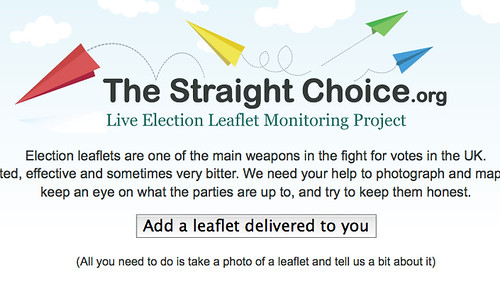
thestraightchoice.org – The Election Leaflet Monitoring Project

Screenshot from The Straight Choice website

The Straight Choice website is a place where anyone can upload any election leaflet delivered to them, so we can all keep track of what the parties are saying and whether it is true:

Election leaflets are one of the main weapons in the fight for votes in the UK. They are targeted, effective and sometimes very bitter. We need your help to photograph and map them so we can keep an eye on what the parties are up to, and try to keep them honest.

It has been put together by 3 very fine people:  Julian Todd who wrote Public Whip with Francis Irving, which became the input for mySociety’s TheyWorkForYou.com. In 2007 he made undemocracy.com which applied the same idea to the United Nations General Assembly and Security Council. Richard Pope was also behind the Planning Alerts project, Groups Near You and StreetWire. He has a track record on this sort of site from the 2005  Election Memory project to record and publicise manifestos of the different parties in the Lambeth local elections. Francis Irving has also done substantial work on mySociety’s WhatDoTheyKnow.com. Great Job.

Very Local Media blossoming in Lozells – but who should keep watering it?

I was really pleased to find the first bulletins from Lozells News – a new child led digital service, appear in my feed stream last week:

Lozells News Highlights from can uk on Vimeo.

This is a project from CAN-UK, who’ve been working from Ladywood for more than a decade. Lozells already has the very fine www.lozells.info and the South Lozells Housing Regeneration area is beginning to use the web to tell the story of how it is progressing, see vision-lozells.org.

A couple of things.

The first is the question of how to integrate these a little better and so seed more local story telling? Perhaps a local social media surgery might help? It is a certainly somehting I’d be interested in.

The other is that our own experience of creating local news with young people  in Frankley or Castle Vale (and others) tells us there remains a problem of how we keep things going once the project ends. There’s no lack of enthusiasm from the young people:  Comments like

this was the best week ive had at Frankley, and making this podcast was a great experiance!

and

can’t wait to see if we do anything else

show there is an appetite for more.  It’s rarely an issue of equipment or websites etc, these are now cheap enough and simple enought to leave behind.  I think the problem is often who will take the lead/ownership in your absence.

So thoughts?  How could we ensure that when the project dosh dries up the storytelling keeps flowing?

Online Petitions for Birmingham City Council.

Kris Kowalewski at Birmingham City Council press office has sent me this:

Online petitions are set to be introduced by Birmingham City Council as a 21st Century way for citizens to express their views on matters of concern.  Under the plans, the new easy-to-use system, accessible via www.birmingham.gov.uk, will go live later this month.

E-petitoners will be able to upload external documents and images as supporting information and follow the progress of their petition through its life cycle thanks to a timeline function.  Additionally the system would give users access to support materials to market their petition to the public and be given the ability to create paper-based versions of petitions to run at the same time.

Those working on the scheme in partnership with the city council include Digital Birmingham and Service Birmingham.  Cllr Paul Tilsley, Deputy Leader of Birmingham City Council, said: “The introduction of an e-petition facility promises to be major step forward for the city of Birmingham.  “It will provide an additional mechanism for people to have their say on issues – strengthening and broadening citizens’ access and participation in democratic decision-making.  “As a council we are committed to embracing modern technologies and enabling citizens to make the most of the digital age. This project is clear evidence of this.”

Funding for the system would be supplied by the EU, which would also foot the bill for any amendments and upgrades that are needed over the next two years.

The most prominent online petition system was created by MySociety for the 10 Downing Street site and has created all sorts of political ructions since it went live in in November 2006. It was an early triumph in the process of using the internet to nurture a conversation between governed and government.  The Downing Street site also gets used for local petitions, such as this one started by the Bradley Stoke Examiner in Gloucestershire.

The Scottish Parliament has also be at it since January 2007 and Kingston upon Thames was one of the first local authorities to get started back in February 2007.

Birmingham City Council will use the Public-i E-Petitions system used by the ones mentioned above and by Bristol City Council.  There is a set up cost this financial year of £7,500 followed by an expected annula running cost of £1,332, currently funded for two years from EuroPetition project.  Source from the Democratic services minutes here (pdf) and here (pdf).

Also see Jon and Stef.