Tag: net2uk

Birmingham Bloggers I think we have a target:

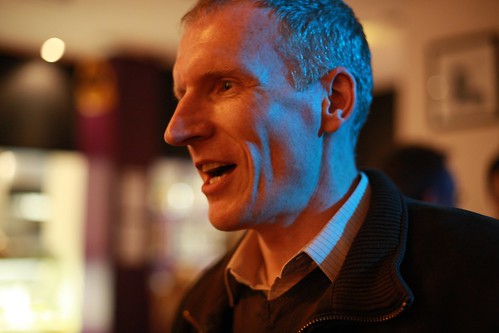
Dave Harte - picture from aeioux on Flickr

For at least 3 years now Dave Harte from Digital Central has been supporting the digital media industry in Brum. Now it’s time to return the favour.

Dave is running the London Marathon next week. He’s been long on training but short on fundraising. Last year he raised £495 for St Mary’s Hospice in 3 months. Now he needs your help to repeat that trick but in 6 days. Why the Hospice…

They deal with those people who are coming to the end of their life and work hard to make those lives and the lives of the people around them a tiny bit more bearable. I’ve not had close dealings with them but I see their building on virtually every training run I do and as I’ve said before I feel a certain elation when I do as it represents the end of a climb and only a mile and a half to home.Have a read of their website to see the full scope of what they do but I think they’re worth the money. So let’s see how we get on. 7 days and counting. Updates on here and on Twitter.

Dave’s job is to run 26 and a bit miles. Ours is to raise £495 before he does his bit. I know which I think is easier! You can donate online here or using this widget (which sometimes doesn’t work) – which of course can also live on your blog.

Downing Tweet : and so the conversation begins.

Downing Street Twitter - want to talk?

More on Downing Street on Twitter this lunchtime, Very friendly, would like to have a name behind the address please and I suppose my feedback would be that until we know who you are we don’t really know how to relate to you.

There has been loads of blog other suggestions since the Downing Tweet Twitter feed appeared last Thursday.

Here on Podnosh we were asking if this was anything special and what the social web might mean for politics and patronage, as we all potentially dance the merry dance of getting digitally close to those in power.

Simon Collister puts us social media enthusiasts in our place by reminding us that:

I spoke to a client’s government relations manager recently about how he communicates with MPs and Peers. His reply was: “Mostly by phone or letter…. Although some are starting to now use email.”

Emma Mulqueeny is a twitter fan and summarises why it does and doesn’t work:

Twitter rocks – but only if you use the Internet to communicate: email, Facebook, blogs etc. If you don’t it is as pointless as setting up an email account and not telling anyone about it… nothing will happen. My personal use of Twitter has been to share experiences and validate thoughts.

Is “Downing Street” interested in using Twitter to “validate thoughts”. The business of using it to ask questions assumes you need to know answers. So what sort of questions could the Prime Ministers Office ask on twitter? Would it be “How quickly should we get out of Iraq?” or “Purple or Red Tie for PMQ’s”. Most of my Twitter friends use it for both.

Techprogressive (Hello, do you have a name?) offers this sound advice:

be less boring. And be more human. Twitter’s a new form of media — use it that way. Post observations, insights people wouldn’t see in press reports, jokes, reactions to news.

Twitter is about forming relationships with your followers, so it doesn’t work if those doing the tweeting just come off sounding like public relations bots

Nils at NDNL echoes all these suggestions and expands on them a touch:

So, @DowningStreet, tell us who you are and keep things worth our while. Know we’re a different audience. Make sure any “news” you push our way has that sense of immediacy we’ve come to know and love over at Twitter.

If you, and others, keep that in mind, get personal with us (can you?) I suppose this will work. If not, the unfollows will hit you harder than you’d held possible and the, essentially great, idea will founder.

Meanwhile our own Brummie web news guru Paul Bradshaw offers a techie slap on the back over at Poynter:

so far their feed mostly offers a kind of Twitter shovelware using Twitterfeed. But that’s not bad in itself. Actually, I think it shows a higher level of tech savviness than simply twittering.

So I’d like to sum this all up into “Hello my name is Nick: what’s yours?”

Why should leaders blog?

That’s the question thrown my way by Simon Peters at Common Purpose as this international leadership charity sets out to start it’s own blogging experiment. So why?

follower or leader  copyright pinkbettyLeaders need followers and followers need to know if they can trust you.

A blog helps establish how trustworthy you are. It is a patient process, but, over time, if you write about the things you care about, link to the people who make sense to you, share questions online it paints a picture people can trust. It reveals who you are and why your vision makes sense. Of course if you tell your PA to do that for you it won’t work.

Leaders not only need followers, they need help.

Problems are usually best solved collaboratively. Collaboration is at its best when there is a diversity of opinions available. Blog about a problem you need to solve and the network you can establish around your blog will help you solve it. This is leadership in a world where hierachy is often the block to progress. Blogger Tessy Britton (link) can help me explain this:

the amount of technical information is doubling every 2 years, there were 3000 books published today, 2.7 billion searches performed on google this month . . .

Which is why computers are no longer optional… and why social network sites have literally exploded. We need to manage all the connections and all the information. The truth is really quite profound. We cannot manage without people networks, where we have connections with lots and lots of other people. And with those connections can come a measure of confidence. Perhaps we don’t need to be trying desperately to absorb so much information, perhaps it is OK to let others know lots of other things we don’t . . . but are only a click or a call away? We need people, and we need to build trusting relationships with those people in order to collaborate.

I think that that this is a truly wonderful thing.

Why else? Followers are clear about what they expect from their leaders, and the openess it takes to blog well can encourage some of those qualities.

In 2005 the DTI commissioned leadership company Caret to carry out the biggest ever survey of followers. They asked 5,000 people what they looked for in their leaders. The results (link here) were interesting, although not surprising:

An inspirational leader ….
• Has an ability to manage and engage people: they listen, involve, trust, appreciate, have fun; they care and involve everyone.
• Is honest, open, respectful, committed, focused, determined, courageous, humble, patient, vulnerable, energised, reflective, passionate, non-jargony, curious.
• Has a novel outlook: looks laterally, bends rules, loves pressure, is highly accessible, strongly visionary, and customer-obsessed.
These are the things followers said would inspire them.

Qualities many of us show in everyday life, with our friends and family, but we can tend to put them aside when we have to function as part of an organisation.

Blogging helps you find your voice, it helps you understand what you naturally believe in, and then challenges those beliefs. It exposes you to a global set of ideas and examples riddled with novelty and invites you to join a conversation, sometimes leading, sometimes following; sometimes learning, sometimes teaching.

It makes you accessible, encourages you to communicate in plain language, it requires you to stick your kneck out, expose yourself and learn from doing so. It works best when you are patient about building a valued network, curious about others people’s ideas, generous with your own.

See any parallels?

Disclosure. I’m a Common Purpose “graduate” (I don’t like that term) from Birmingham in 2000 and 2003. I’m also an associate consultant with Caret – the DTI sponsored research was completed before I joined.

Image thanks to pinkbetty on Flickr.

Update: April 17th 2008. You might be interested in this new blog on leadership.