Here are some of the things I’ve been reading August 8th from 12:43 to 13:15:
Citizen involvement in local governance | Joseph Rowntree Foundation – “This Round-up outlines the challenges and dilemmas that local partners, central government, councillors, staff and communities must resolve if citizens are to have more power and influence over local services and their neighbourhoods.”
Where British blogging is at | The Democratic Society – Demosc worries about whether blogging can replace msm: “a lot of sympathy with his scepticism about what blogging brings to political debate. It may be that it grows up, or that the cream floats to the top, if the traditional media do go under.” Medium and message mix up again?
Even more thing I found in my feed reader after a while away
The new model for journalism: Hyper-local, collaboration and aggregation « How to microblog in high heels – Hanah Waldram, she behind the hyperlocal site for Bournville says about Help Me Investigate (I site I helped set up) “hyper-local, collaborative and aggregation seem to me to be key terms in the future of local journalism online. And I’m excited my home town Birmingham is pioneering such innovative and exceptional work.” Thank you Hannah
Finding Innovation in Design – Bokardo – Joshua Porter is interesting on how websites should start by mimicking existing and current behaviour, before attempting to lead users towards some new combination of behaviour.
Towards a New Golden Age of Rail? | Andy Howell – “I never thought I’d be praising the work of Lord Adonis. But now this famed train spotter has begun to unveil his vision for high speed rail I’m going to have to take my hat off to him.” Andy Howell on the hope for a high speed rail link from Birmingham to London. Despite high levels of digital connection it would certainly make my work easier. The web has made me want to meet more people and get more done, that means better transport. Now where in Birmingham do we have the space for a shiny new train station… umh, there’s some empty land behind Curzon Street.
Islamophobia: only 10% of Muslims believe discrimination is on the basis of religion « walls come tumbling down – I ink to this partly because it’s intersting and partly to encourage you to keep tabs on Chris Allen’s blog: “the evidence base for Islamophobia is remarkably weak and so offering any comparison between this and other forms of data remains extremely difficult. Nonetheless, if the findings are correct, then it may be time to re-consider the way that Islamophobia is perceived particularly when the reality and the perception appear to be so different.”
Screen WM – Roger Shannon writes about Jill Balcon – I link to this simply because one of the first films I ever made when i was working on the first series of Inside Out for the BBC was about Balcon and the other famous movie entrepreneurs who worked out of Birmingham in the 1920’s. it was presented by Adrian Goldberg an included a wonderful interview with Roger Shannon. In fact the whole piece was essentially Roger’s idea.
Total Place and Accountability « Philip Parkin – Birmingham Councilor Philip Parkin also has views on Total Place: “the conversation about how to best scrutinise the unelected should have begun a long time ago.” in 2003 I ran a quango called Birmingham City Pride, who had as part of it work scrutinising the Local Strategic Partnership. It was a rubbish idea because the organisation which paid us to scrutinise the Local Strategic Partnership was …. yes you’ve guessed it.
Birmingham Post – Cost of new Birmingham City Council website spirals to £2.8m – This story originally emerged from a Freedom of Information request made as a result of an investigation started by Josh Hart on http://www.helpmeinvestigate.com. At first the Post piece failed to acknowledge the work of volunteers that had made their story possible, but after being prompted they put that right. If you read the comments you’ll see they gained respect for doing just that. The Birmingham Mail also amended their story to acknowledge Heather Brooke, who submitted the FOI
Roy Greenslade: Murdoch is wrong to charge for online content | Media | guardian.co.uk – I’m with Roy on this one: “Journalists have skills, valuable skills, but the net allows new forms of collaborative journalism that does not recognise the need for barriers. We want to see journalism develop, not return to the days in which an elite minority acted as secular priests, telling people what they thought they ought to know. “
Confessions of an Aca/Fan: Archives: The Struggle Over Local Media: An Interview With Eric Klinenberg (Part Two) – Cart before horse argument going on here: “young people may not miss reading the local newspaper, but they would be very concerned if they could no longer get reliable local journalism online because the paper had fired so many reporters or even closed. They would notice if their favorite bloggers suddenly had less material to comment on or extend, or if their local TV news got even dumber because there was so little reporting to repackage. If the media is an eco-system, newspaper reporting remains its sun, even in a digital age. When it diminishes, so does everything else. “
Citizen Engagement « Policy and Performance from IDeA – :A range of projects to promote citizen engagement are being sponsored by CLG under the aegis of the snappily titled Citizen Engagement Tools Sub-Programme Board.”
A41 Warwick Road Route Enhancements – A-social media from this local government consultation site. It uses wordpress but doesn’t allow conversation. It’s a classic case of consultation being understood as you tell us, on a one to one basis. Wrong, and I’m not interested in being told “we’re learning”. You’re not!
Help Me Investigate allows people to ask civic questions and work together to find answers. Since it emerged into life a couple of months ago people have sought answers to questions ranging from:
“Why wont’ Birmingham City Council hand over the running of Lightwoods Park to Sandwell Council”
“Help me investigate why my doctor has an 0845 number”
“What is the tracking process for petitions handed into Birmingham City Council.”
The site feels quite Birmingham centric at the moment simply because we are experimenting using questions about the place where many of us live. As the site evolves that will change.
Who pays for this?
It is funded by Channel 4’s 4ip fund, Screen West Midlands and Advanatage West Midlands and it’s launch attracted interested from the mainstream media. The Guardian summed it up like this:
Rather than a publishing platform, the site is a tool that could equally benefit news organisations and the public; it follows the MySociety mould of successful activism sites like TheyWorkForYou and FixMyStreet.
“Journalists think investigative journalism should be very secretive, but [HelpMeInvestigate] has to be seen to be owned by the community than by journalists because that puts off the public. People can contribute their expertise to answer specific questions, and journalists with no resources could use the site to call on the community for help.”
Today the site, still in a private experimental phase, saw it’s first spin off mainstream media news story.
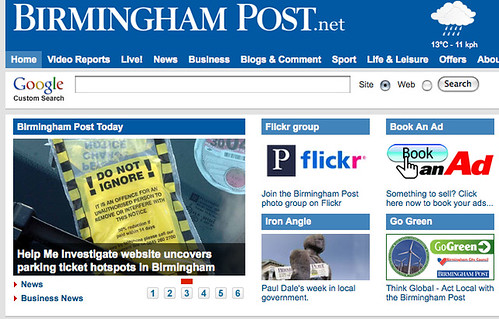
The Birmingham Post runs an HMI story on Parking Tickets.
This morming the post ran this story about how HMI had found the worst street for parking fines in Birmingham. The story began here, with a question from Heather Brooke:
Help me investigate on which Birmingham Streets are the most parking tickets issued?
It’s an interesting HMI question because it is about something which bothers many of us, but it’s also specific and local. It’s also a classic local newspaper question, but what thye may not take the time to ask.
The next stage was a freedom of information request, which you can see here on MySociety’s brilliant WhatDoTheyKnow service, which makes FOI requests public and easy to make.
When the information finally arrive in three files another user of the site stepped into to help. Neil Houston likes messing around with spreadsheets (part of the point of Help me Investigate is to allow people to play to their strengths).
He quickly established the 10 worst places to park for ticketing were:
•Alum Rock Road, Washwood Heath (3,995)
•Stratford Road, Sparkhill (2,418)
•Corporation Street, city centre (1,748)
•Alcester Road, Moseley (1,545)
•Waterloo Street, city centre (1,455)
•High Street, Harborne (1,391)
•Gas Street, city centre (1,083)
•Whittall Street, city centre (1,022)
•St Paul’s square, Jewellery Quarter (1,008)
•Dean Street, city centre (978)
Neil normally blogs about food, so even though he wanted to right about this he didn’t want to contaminate his normal blog. He borrowed some space on Be Vocal to write this piece, including the observation that:
it’s surprising to see that the warden BM739, issued 5,080 tickets. The next ‘top’ ticketer issued 3,559. This shocked me, as that’s a LOT of extra tickets by BM739.
Tom Scotney at the Birmingham Post started to use his papers position to seek explanations for the figures from the council, and this morning he posted the article including explanations for these questions: 1/2) Why is Alum Rock Road the most ticketed area in Birmingham?
3) Why did the number of tickets given out rise significantly over the last full recorded year?
So what do I make of this?
Thanks to the Birmingham Post for running the story and more importantly sharing credit for the story. It’s important for news organisations to get used to being open and generous with sources.
It’s good to see citizens and journalists (who are also citizens, I know) collaborating with each other to get to the bottom of something
This one set of data has already triggered new questions about car clamping and could lead to a flurry of similar questions across the country.
The other thing to remember though is that this may not be typical of what happens on Help Me Investigate. This is a question which has general interest, hence useful for a mainstream news organisation. Many of the questions though may be, on the face of it, more mundane and more about how thre system works or perhas problems that are very very local.
For these the collaboration could involve public servants using the questions as a means to improve the work they do. At least let’s hope so.
These are my links for July 22nd through July 25th:
Message in-a-Box – Do you want to use multimedia, online or offline tools to advance your cause? Creatively and effectively? To reach the broadest possible audience?
Helen Milner: Digital Britain sees digital inclusion emerging from the chrysalis – Helen writes: “From my point of view the evidence is clear, and it’s the link between social and digital inclusion which remains most concerning and most urgent. Those already at a disadvantage are up to seven times more likely to be digitally excluded.”
Jackie Hai | Convergence Commons – “There’s a simple reason why no iTunes for the news exists yet: it’s because the journalism industry has thus far failed to produce any songs worth buying. For that matter, the journalism industry has produced very few songs at all — the staggering majority of stuff being circulated today is commodity news, contextless updates with no replay value after being consumed once” via @paulbradshaw
ASH-10 » Echoworking – Pete Ashton on the new Moseley exchange Co-working (Cow Orking) space in Birmingham. My view is that it’s utterly brilliant that one of our neighbourhoods has such a fantastic thing for small businesses and creative types.
Manage Cookie Consent
To provide the best experiences, we use technologies like cookies to store and/or access device information. Consenting to these technologies will allow us to process data such as browsing behavior or unique IDs on this site. Not consenting or withdrawing consent, may adversely affect certain features and functions.
Functional
Always active
The technical storage or access is strictly necessary for the legitimate purpose of enabling the use of a specific service explicitly requested by the subscriber or user, or for the sole purpose of carrying out the transmission of a communication over an electronic communications network.
Preferences
The technical storage or access is necessary for the legitimate purpose of storing preferences that are not requested by the subscriber or user.
Statistics
The technical storage or access that is used exclusively for statistical purposes.The technical storage or access that is used exclusively for anonymous statistical purposes. Without a subpoena, voluntary compliance on the part of your Internet Service Provider, or additional records from a third party, information stored or retrieved for this purpose alone cannot usually be used to identify you.
Marketing
The technical storage or access is required to create user profiles to send advertising, or to track the user on a website or across several websites for similar marketing purposes.