Category: Government

Obama voters expect him to keep the conversation going in government

Pew Internet released this report (pdf) just before the New Year which tells us that Americans who voted for Obama are expecting unprecedented levels of connection with his government:

Obama supporters who use email and social networking sites not only expect continued
communication with the administration through these channels, they also expect these
communications to occur with greater frequency than mail or telephone contacts.

  • 37% of Obama voters who use social networking sites expect to receive updates from the administration on these sites. Most expect to receive these updates on either a weekly (12%) or monthly (11%) basis, while 14% expect them to occur less frequently.
  • 34% of Obama voters who use email expect to hear from the new administration via email. One in ten (10%) expect to receive these email contacts on a weekly basis, and 9% expect to do so monthly.
  • 38% of all Obama voters expect to hear from the administration via mail. Some 7% expect to receive mail from the new administration on a weekly basis and 12% expect to do so monthly, while 19% expect to be contacted by mail just a few times a year.
  • 17% of all Obama voters expect to receive phone calls from the new administration at least occasionally. Just 2% expect to receive phone calls on a weekly basis, and most (10%) would prefer these communications to take place a few times a year.
  • 11% of Obama voters who own cell phones and use text messaging expect to be contacted by text messaging, with most (6%) preferring that these text message contacts occur less than once a month.

That’s a awful lot of conversation and it will only be fruitful if Obama’s team and the government they inherit find new ways to pass authority and permission down the food chain. This is not potential, as we have with UK government. This is a reality which will be tested from this month onwards. Hat-tip.

Why doesn't government have reservists?

It starts here

The role of government is going to change.  As individuals find it easier to collaborate and solve problems, traditional government structures will need to be reshaped and rewired. So how do we start this change?

The people’s pilot light

I first found myself thinking of the role of government as a “pilot light” at a Department for Communities and Local Government event on digital inclusion. Most government bodies are prone to consider themselves as somehow permanent but what would they be like if they got their collective heads around being only sometimes on? The pilot light on the boiler that hums quietly away, then sparks into life when things get a bit chilly.

That, of course, is very Keynsian and at the moment government is turning itself to full roar and bunging on all 4 rings on the gas cooker in an attempt to get some heat back into the economy.

What is interesting though is how we habitually structure most government on an assumption of permanence.  That means that when we need more government we struggle to find the capacity and when we need less we are clumsy at shrinking, often reluctant to scale it back and put the excess capacity to useful work elsewhere.

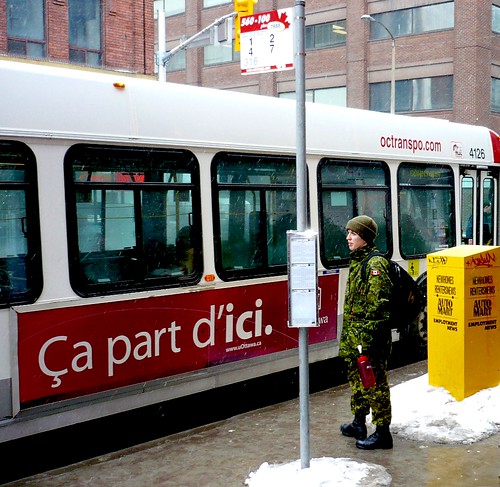
32nd Birmingham and District Leisure and Tourism Light Foot (reserve)

This is why I think government needs reservists.  In the good times these people will be working happily in private industry, training a couple of weeks of the year with government oppos, creating links and bridges that wouldn’t otherwise exist, speeding up the modernisation of government by sharing new ideas and ways of working.

Of course social/private firms and the third sector already provide contractual spare capacity for government.  – I’m wondering if it makes sense to create some stronger culture of treating government as something that gets deployed where and when it is needed.

Rehydrate in case of emergency.

We need to create the core notion of government that grows and shrinks depending on the task in hand.  This habit will be key to responding to self organising citizens.  Why clean a street if the people who live there use some of their combined social capital to keep it clean for themselves? Often it’s simply because we planned to clean it, it’s our job – what are they doing cleaning it anyway!

This is not a complete answer, nor a wholly formed thought, so help me here please.  How do we re-structure government to respond to widespread self organising citizens?

(image “It starts here” from Mikey G Ottowa.)

Social Media and Social Housing

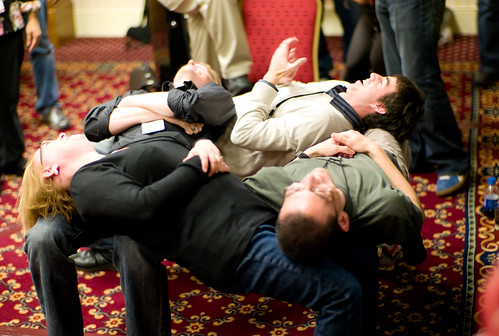
Trust from Joi on Flickr - click image to see the original.

This afternoon I spoke at the National Housing and Disrepair Forum annual conference. 100 or so council officers, solicitors, barristers, housing association types and others worrying about just how much money is spent on compensating council tenants for repairs that haven’t been done. This is a link to the presentation:  Talk is cheap – so use it more.

I was invited by Kate Priest, the head of the legal department at Birmingham City Council that deals with such matters.  Kate had heard me talking about local government, social media and the changing democratic relationship in one of my sessions at the Institute of Local Government.

A £3,000 pound compensation bill for a tenant could mean a £15,000 bill from their lawyers – and all that comes out of the repairs budget. So it’s worth exploring other ways to stop this.

I wanted to get across the idea that this can be thought of as a problem of trust. Lawyers thrive where trust does not. The challenge I wanted to throw to the group was how can they understand this as more than a problem of record keeping, accountability and process? Instead can they involve their people in sincere networks of trust within neighbourhoods.
The presentation is simply designed to offer examples of how and where the social web builds real networks of trust – ones which can make things happen. It was intended to give them a sense that trust is worth hard cash. The tenant who trusts their council worker and so negotiates directly with them could free up thousands for work of public value.  The tenants who are part of a wider network of trust may even be able to help negotiate priorities.

Thank you for a big chunk of input on twitter (image here and here of the 19 comments). Here is what you suggested:

By presenting an authentic face to tenants which listens and responds to their concerns and issues and by helping to link tenants up to find others in their situation, or who have resolved issues to share experience and connect”  Dave Briggs.

Listen to people where they are already talking about you (good and bad stuff)” Paul Henderson.

“Any way of improving two-way communication must surely help” Catnip.

Councils need to improve / review their relationships offline before making a difference online”  Stuart Parker.

One easy win would be for blogs to be set up for individual estates – the council can keep tenants fully in the loop of developments, the tenants would be able to have their say, but also that blog could help develop & bind the community of the estate itself together. wins all round, for minimal financial investment, really.”  Simon Gray.

Not a council tenant, but as a private one an answerphone and email address would be a start!” and “I think the question’s wrong: maybe, ‘what are the problems facing council tenants’ and keep soc media in mind when addressing them ” Michael Grimes.

“This is helping in some respects, esp with young people on 1st tenancy http://www.inliving.co.ukJohn Popham.

If social media is ‘informal’ it will help get over the “stigma” of phoning somone or appearing in person.” Paul Jennings.

Human face and interaction with two-way content. Would also bring tenants into contact with each other as well as council.” Nicky Getgood.

I think councils are way off social media. Difficult to control comms leads to degraded service. Also privacy issues and challenge of delivering service using tools and channels that are external. Eg what if Twitter down? Ian Edwards.

Google alerts for blog posts about “dog sh*t” or “broken paving slab” + their ward, then follow it up. That’s only a semi joke”.  Jon Hickman.

Blogging for different estates. Would get people to know each other and get them talking about issues that matter to them.”  Antonio Roberts.

Works t’other way- CLG wants tenants 2 have a role in mgmt- better way 2 engage than endless meetings (although meetings r useful)”.  Nick Drew.

Toronto based Michael Cayley also asked: “ pls share some references used for trust & social capital session aimed at lawyers who defend councils from housing repair claims.

I used very simple examples. I was facing an audience of 100 people, none of whom blog, only one had heard of twitter.  Even though I was amongst many lawyers only a smattering had come across Linkedin.   I needed to show how building networks of trust can help make good things happen.  I used the example of the Birmingham Bloggers group and the Social Media Surgeries. I used the volunteer effort that mysociety can apply to ventures like  fixmystreet (and not a soul in the room  had heard of the site). I also talked to them about the open innovation exchange experiment and how it’s model of open collaboration to pitch for contracts is using trust to disrupt existing ways of doing business and improve the outcome for the public.

Responses were mixed. Some went for the very human (my favourites) such as getting good at saying sorry, takings flowers when you’ve messed up and having street meeting with contractors. Others talked specifically about  procedures and software to track transactions.  One reported how law firms use facebook to recruit people for court cases.

Overall I tried to emphasise that I wanted people to go away not so much thinking about the internet, but appreciating that whatever they can do to build trust should ultimately reduce their need to fight fruitless court battles with the very people they exist to help.

We’ll see what comes next.
EDM 2141 – please write to your MP.

Update, Turns out Lynne Jones has already signed this – check here. Teach me not to check first!  Good news.


Spurred on by Simon – and nicking some of his text I have sent this to my MP – the very independent Lyne Jones.

I am writing to ask you to sign EDM 2141, tabled in July by Lib Dem MP Jo Swinson, in support of the Free Our Bills campaign by charity MySociety.

MySociety’s pioneering work is recognised worldwide. You will probably have seen their site, TheyWorkForYou, which makes Hansard infinitely more usable on the internet. They are seeking Parliament’s assistance to do something similar with bills, to allow the public to see the laws being drafted and published on their behalf.

Whilst recognising the motion has been tabled by a LibDem member, and that EDM signatures can sometimes be motivated by party affiliations, I would note that senior figures in your own party have spoken in favour of freeing public data. Not least Tom Watson, who’s work as Cabinet Office Minister is encouraging collaboration on new ways to get public value from public data. This is precisely what MySociety is proposing for Westminster.

MySociety’s track record shows that they can and will deliver. They are proposing changes which will take little time, cost little money, and have no material impact on current working practices.

I urge you to show your support for this important principle; and to take a few moments to sign the EDM in question.

I encourage you to do likewise. But only nick bits of this letter.