Category: Citizen Journalism

Help Me Investigate’s first spin off story for the maintream media.

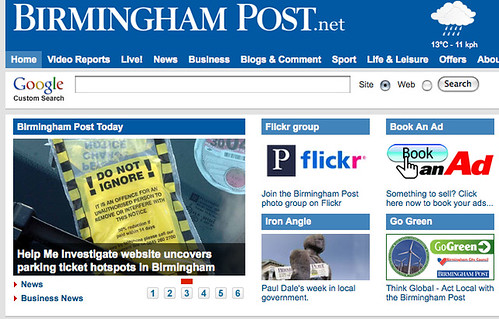
Birmingham Post on help Me Investigate

Whether it is the social media surgeries, the grassroots channel podcast or Be Vocal I’ve always been interested in helping active citizens find new ways to collaborate and communicate.

So it is with Help me Investigate, a site I’ve helped establish alongside Paul Bradshaw (who had the original idea) and Stef Lewandowski (who’s building our prototype site).

Help Me Investigate allows people to ask civic questions and work together to find answers. Since it emerged into life a couple of months ago people have sought answers to questions ranging from:

  • “Why wont’ Birmingham City Council hand over the running of Lightwoods Park to Sandwell Council”
  • “Help me investigate why my doctor has an 0845 number”
  • “What is the tracking process for petitions handed into Birmingham City Council.”

The site feels quite Birmingham centric at the moment simply because we are experimenting using questions about the place where many of us live. As the site evolves that will change.

Who pays for this?

It is funded by Channel 4’s 4ip fund, Screen West Midlands and Advanatage West Midlands and it’s launch attracted interested from the mainstream media. The Guardian summed it up like this:

Rather than a publishing platform, the site is a tool that could equally benefit news organisations and the public; it follows the MySociety mould of successful activism sites like TheyWorkForYou and FixMyStreet.

“Journalists think investigative journalism should be very secretive, but [HelpMeInvestigate] has to be seen to be owned by the community than by journalists because that puts off the public. People can contribute their expertise to answer specific questions, and journalists with no resources could use the site to call on the community for help.”

Today the site, still in a private experimental phase, saw it’s first spin off mainstream media news story.

The Birmingham Post runs an HMI story on Parking Tickets.

This morming the post ran this story about how HMI had found the worst street for parking fines in Birmingham.  The story began here, with a question from Heather Brooke:

Help me investigate on which Birmingham Streets are the most parking tickets issued?

It’s an interesting HMI question because it is about something which bothers many  of us, but it’s also specific and local.  It’s also a classic local newspaper question, but what thye may not take the time to ask.

The next stage was  a freedom of information request, which you can see here on MySociety’s brilliant WhatDoTheyKnow service, which makes FOI requests public and easy to make.

When the information finally arrive in three files another user of the site stepped into to help. Neil Houston likes messing around with spreadsheets (part of the point of Help me Investigate is to allow people to play to their strengths).

He quickly established the 10 worst places to park for ticketing were:

•Alum Rock Road, Washwood Heath (3,995)
•Stratford Road, Sparkhill (2,418)
•Corporation Street, city centre (1,748)
•Alcester Road, Moseley (1,545)
•Waterloo Street, city centre (1,455)
•High Street, Harborne (1,391)
•Gas Street, city centre (1,083)
•Whittall Street, city centre (1,022)
•St Paul’s square, Jewellery Quarter (1,008)
•Dean Street, city centre (978)

Neil normally blogs about food, so even though he wanted to right about this he didn’t want to contaminate his normal blog.  He borrowed some space on Be Vocal to write this piece, including the observation that:

it’s surprising to see that the warden BM739, issued 5,080 tickets.  The next ‘top’ ticketer issued 3,559.  This shocked me, as that’s a LOT of extra tickets by BM739.

Tom Scotney at the Birmingham Post started to use his papers position to seek explanations for the figures from the council, and this morning he posted the article including explanations for these questions:  1/2) Why is Alum Rock Road the most ticketed area in Birmingham?
3) Why did the number of tickets given out rise significantly over the last full recorded year?

So what do I make of this?

  • Thanks to the Birmingham Post for running the story and more importantly sharing credit for the story. It’s important for news organisations to get used to being open and generous with sources.
  • It’s good to see citizens and journalists (who are also citizens, I know) collaborating with each other to get to the bottom of something
  • This one set of data has already triggered new questions about car clamping and could lead to a  flurry of similar questions across the country.

The other thing to remember though is that this may not be typical of what happens on Help Me Investigate. This is a question which has general interest, hence useful for a mainstream news organisation.  Many of the questions though may be, on the face of it,  more mundane and more about how thre system works or perhas problems that are very very local.

For these the collaboration could involve public servants using the questions as a means to improve the work they do.  At least let’s hope so.

Social Media Help – support for local groups blogging.

If you look at the top of this page you’ll see a new set of pages called Social Media Help.  They are an extension of some work we have been doing for Groundwork UK on the Big Lottery Community Spaces fund..

With tight resources we wanted to provide some simple guidance for any community groups who use social media as they  apply for or perhaps spend the Community Spaces fund dosh.  My favourite of all is this wonderful blog post from the Friends of Abbey Gardens, but other groups are at it, including Macclesfields Skate Park group, Fairland Park, and  some consistent blogging from Roy at Meols Park.

The help section is available on their site and here.  It will also be useful for the facilitators who help groups with contracts etc.  there are 50 of them and we neither had the time or the desire to try and show all 50 how to blog etc.  For those do want to encourage local groups to use social media it’s a starting point.

The help section is available on this site and here and the end result is:

We’ve compiled some practical articles and videos to help you get the most out of using social media to tell your story. You can go through them one at a time, or dip in and out. Each section has a search facility to help you get to useful nuggets of information from trusted help and support sites.

  1. Tips for blogging with WordPress
  2. Tips for sharing pictures with Flickr
  3. Tips for sharing videos with YouTube
  4. Tips for using Twitter
  • What makes the web social?
  • It deliberatley only covers a few services because we dont want to clutter things up for beginers.  Thanks very much to Paul Henderson for pulling this together.  Feel free to use it for social media surgeries and the like.

    About Brum podcast features social media surgeries

    Some of you may know that podnosh began as a podcasting business in 2005, with the Grassroots Channel – audio stories of active citizens in Birmingham.

    At the last social media surgery Christopher Woods interviewed me for what has become the first episode in his freshly minted About Brum podcast.  You can listen below, and it’s worth it, because Christopher has a very appealing and relaxed style.

    “Councils are no longer dependent on traditional media to communicate their messages”

    This has come from Vicky Sargeant at the Socitm press office and I offer it to you verbatim simply because I don’t have time to fully digest it and add links just now, there doesn’t seem to be a apge to link too, but I don’t want to forget to share it with you:

    News Release:

    County Councils saw their web traffic double last Friday and Saturday thanks to their provision of a sophisticated online election results service coupled with use of social media tolls like Twitter, Facebook, RSS feeds and email alerts.

    Figures from the Socitm Website Takeup service, subscribed to by more than half of all county councils show that on Friday 5th and Saturday 6th June, web traffic to county council websites was more than double that of the Friday and Saturday of the previous week.

    This trend is bourne out by results from individual councils like Derbyshire, which last Friday saw the highest ever number of visits to its website in one day including more than 19,000 visits to its election section alone.

    The sophistication of the election results coverage by councils through their websites has been captured through a survey by Socitm Insight, publishers of the annual Better connected report on council website quality. The survey looked at websites of county councils and new unitaries where elections had been held to see how the results were being reported. It followed a similar exercise carried out at the last county elections in May 2005.

    The survey found that almost all councils were reporting results on their websites ‘live’ or as near to real-time as possible and were carrying very prominent links and features on the home page. Many included some form of interactive map, summary tables and charts or other graphics to allow visitors to follow the results as they happened and to access a summary in various forms. Some councils provided TV style graphics including ‘virtual council chambers’ filling up with figures in party colours as the results came in.

    A few councils provided a live online comparison with previous election results, showing whether seats were being held, lost or gained. A number of councils stated when the count was due to start, but even better were councils who offered an estimate as to what time the first result was likely to be expected.

    Nine councils were also promoting their use of RSS feeds and / or Twitter to publish the results, using these opportunities for to enhance their interaction with the public through these new channels. During the results period, fans on Derbyshire’s Facebook page rose from 22 to 73 and their Twitter account followers rose from 122 to 335. Derbyshire’s Facebook ‘fans’ were contributing comments, and responding to one another as the day unfolded. One said ‘Local newspaper site reporting recounts in Long Eaton while Twitter and @derbyshirecc knows its over. SO behind. V. poor compared to you guys. Many thanks for all the hard work pulling this together today’.

    Other innovations noted on election pages included:

    • Norfolk County Council – featured its YouTube video on why you should vote
    • Lancashire County Council – offered the facility to subscribe to receive results by e-mail
    • North Yorkshire County Council – featured a video about how the democratic process works

    Surrey County Council – charts included a summary of holds and a swing chart
    ‘Our survey provides evidence of the opportunity local councils now have to use their website and social media tools to engage with and inform local people as never before’, says Martin Greenwood, Programme Director for Socitm Insight. ‘Councils are no longer dependent on traditional media to communicate their messages and can outperform them anyway as a source of immediate, authoritative and totally up to date information – we have seen this with local emergencies like flooding, and now with elections. Councils should be seizing this new opportunity with both hands.’

    More Socitm news here.