Posts Tagged ‘Third Sector’

Who are social media surgeries for?

Posted on 22nd March 2012 by

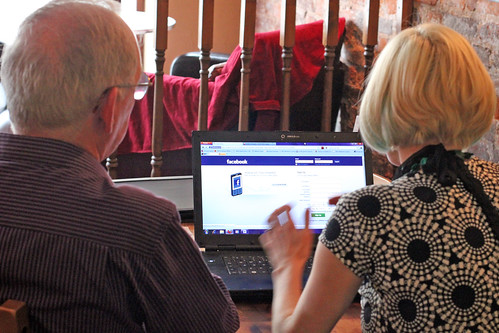
Melissa helping someone learn about Facebook at Dudley Social Media Surgery

This post summarises emails I’ve sent in response to enquiries about the Central Birmingham Social Media Surgery I coordinate – and advice to other Surgery Managers.

It’s about my personal take on what – and specifically who – the surgeries are for. It also stems from feeling protective of the helpers who volunteer their time and skills for free at the surgery, the very social capital that makes the surgery work.

(more…)

Community Lover’s Guide To The Universe and Birmingham

Posted on 29th November 2011 by

Spines of Community Lover's Guide books arranged on a shelf

It’s been a little over 5 months since we first mentioned The Community Lovers Guide To The Universe : Birmingham and we’ve finally found some time to get around to to approaching people to write chapters for us.

Jo Burrill and Birgit Kehler are going to be covering Change Kitchen, Emma Woolfe will be writing about The Friends Of Cotteridge Park, Christ Unitt will be telling us about Created in Birmingham and James Yarker will be writing about Stan’s Cafe “Of All The People In The World” and there are still some email responses pending from other interesting projects we’ve contacted.

We’re hoping that the The Community Lovers Guide: Birmingham will be ready to be published by early next year, but that of course all depends on us getting all the content we need in time. So while we’re making a start approaching the groups from the suggestions in the comments of the last post Can you think of any other people/projects that would like to contribute? A lot can happen in 5 months and we’re just wondering if there is anything happening that may have slipped under our radar.


New report counts cuts to spending in the UK voluntary and community sector

Posted on 8th August 2011 by

Counting the Cuts: The impact of spending cuts on the UK voluntary and community sector is a new report published today by the National Council for Voluntary Organisations (NCVO).

Following a collaborative project to map stories of voluntary groups told their funding will be reduced – and analysing the government’s projected spending plans for the Spending Review period 2011–2015) – NCVO estimate “the voluntary and community sector is facing nearly £3billion in cuts over the next five years.”

(more…)

Social media surgeries, simplicity and being there

Posted on 22nd June 2011 by
A proper cup of tea

A proper cup of tea by James Shade on flickr


I often say this about social media surgeries: please keep it simple.

Why?  Because the most important single thing about a surgery is that it should be there.

Being there is a core part of supporting communities.  Month after month they know you’ll be there, they get used to it, they get used to the relaxed format and they come for help, come for ideas, come for connections, come back to offer help.

It is just a truth that something is more likely to happen if it’s simple.  A cup of tea with a friend is much more likely to happen than (more…)

The Big Society in Action – notes from another session at the Conservative Party Conference

Posted on 5th October 2010 by
Rory Stewart MP, Professor David Eastwood, Ben Lucas and Professor Helen Sullivan

Rory Stewart MP, Professor David Eastwood, Ben Lucas and Professor Helen Sullivan

I’ve just come away from a very thought provoking Big Society discussion hosted by the University of Birmingham and Demos at the Conservative Party Fringe.   I think Rory Stewart MP gave one of the most lucid explanations I’ve yet come across.  Here are my notes

Rory Stewart is the new MP for Penrith and the Borders in Cumbria. His constituency has been one of the pilot areas for “Big Society” – he writes about that here:

Big Society isn’t a Sphinx without a riddle or an excuse for no funding or a mystical construct.

It is clearly not about the government per se, the individual or business, probably not primarily about the voluntary sector. It is about community, particularly about local democracy.  To use a Bhuddist analogy the noble truths might be….

  • We have a World dominated by government that is to rigid
  • Solution to this is de-centralisation
  • The path is through something called the big society

Big Society is not an object so much as an activity, not a funding stream or a pot of money.

Concrete example in Cumbria re rural broadband… attempting to install super fast broadband faster and cheaper than government would do it.  14 to 15 billion would be the government cost. In Cumbria we are breaking into the fibre that runs into schools, creating cabinets and encouraging communities to tap into thoise  Farmers can dig their own trenches bringing prices down to 15% and get it done in 2 years instead of much longer.  Here government provides soft loans – access to infrastructure. The government was never going to be able to do this – communities organised through parishes to give them democratic legitimacy can do this.

Ben Lucas of the 2020 Public Services Trust

My concern is that it could undermine the value of the Big Society idea in it by trying to be two things at one time

  • A rhetorical distanceing from the idea that there is no thing as society.
  • Also a way of emphasising relative importance of civic society against the role of the state.

Very strongly support much of what lies behind it.  Some people have interpreted it as just about volunteering – it clearly isn’t.   It is partly about re-thinking the role of the state. Social value lies in the quality of the interaction between the state and the citizen, for example if citizens don’t play their part in improving their health it doesn’t matter how good the local hospital is, public services are essentially co-produced.

One of the area of interest for him is how do you link effective social institutions with effective social networks.  Jospeh Rowntree did a piece of work on communities in recession with high levels of unemployment.  The ones that are more resilient are the ones with more community ownership in the neighbourhood.  Questions…

  1. How do you finance up front social investment in a recession?
  2. Quality of the public realm – how can local authorities not do the obvious things, cutting their non core services – which might
  3. What is the role for the voluntary sector – the real future is the creation of new institutions, local mutual, citizen run.

We need to keep a layer of govt that can coordinate at a city region level.  It’s about a balance between localism and the wider neighbourhoods.

Professor Helen Sullivan, Professor of Government and Society at University of Birmingham going to run

a independant Commission by the University of Birmingham in partnership with Demos.  The Commission will draw together the University’s expertise in local government reform and Demos’ work on capabilities and citizenship in order to contribute to the development of a policy agenda that might effectively and fairly empower non-state actors in society.

There’s no doubt the state has become unfashionable again.  Now regarded as at best outmoded and at worst a block to citizen action and enterprise.  Big Society underplays the vital contribution a well resourced state makes to inequality and key issues, such as climate change.

Fails to acknowledge the inter connection between state and civil society.  Investment has become largely from the state, not private philanthropy.  If the state withdraws then the voluntary sector will not automatically fill the gap.

Re thinking the role of the state

1 Working out more precisely what is meant by the big society, a conversation to be had with the public.  What are reasonable expectations citizens have of the state. People have different motivations for engaging in civil action, often citizens are resisting the state, not doing its will.

2 Taking a localist approach -  this is about the quality of democratic politics.  There’s an assumption that consensus is the norm, but politics and conflict are always present. Local government will need to navigate the tension between communities. How will these relationships need re designing, what does it mean for future raining of government officers. Needs a review of local govt finance

3 Role of the central state.  There is a still a case to say we need national mechanism to address inequalities from local conditions.  For example inequalities over age locally.

The perfect mix for June’s Central Birmingham Social Media Surgery

Posted on 9th June 2010 by

Andy and Lenka talk WordPress

On our way to the June Central Birmingham Social Media Surgery, I worked out that it’s been six months since our first event in the Studio – the first that I was sort-of involved in. In all that time I don’t think we’ve had a better turnout – for the type of people that have come down and the variety of things that they are interested in.

Scanning down the list of names and organisations that turned up, we had – in no particular order – representatives from two hospices, a city centre residents’ group, a campaign for sustainability in Solihull, a basketball club, a neighbourhood forum and people from two social enterprises.

The help

While the Civic Centre Residents Group continued to get help on their posterous blog (it’s their third time down to a surgery), it was great to see people from two hospices come along. Tony Coulson and Daphne Welch of St Mary’s Hospice in Birmingham received help from Michael Grimes with their website. Mark Binnersley, who is also at the St Mary’s Hospice was helped with Twitter by Catherine Howe – who had come from Brighton to learn more about what the Social Media Surgeries are like here in Birmingham and very kindly stepped in when it looked like we were running out of surgeons.

Given that was only five minutes into the evening – and we already had a pretty full set of tables – it was something of a relief. But she wasn’t the only person more than happy to help out with some of the great variety of different issues that we dealt with that night.

Goodbye to Heidi

Heidi Blanton, who has only recently become a social media surgeon, was charged with helping Paula Mitchell and Jane Hartnell of Acorns Hospice. Sadly this is likely to be the last surgery that Heidi can attend, because she’ll be heading back to the USA for a while, but we hope to see her – at least for a visit – in  the not-too-distant future.

Jane and Paula from Acorns

As the audio interview below hopefully explains, Paula and Jane were looking for help with using social networks, such as Twitter and Facebook to better communicate with the many people who have an association with the hospice. But they also had an inquiry about how they might be able to get news feeds onto their websites with RSS – after Paula (who is the first person I speak to on the interview) was approached by someone trying to sell them the service for a very large amount of money!

[podcast]http://podnosh.com/files/2010/06/Acorns-Paula-and-Jane.mp3[/podcast]

Transitions Sutton Coldfield

Another particularly interesting arrival was Lenka Moore, from Transition Sutton Coldfield. I’d not heard of Transition before tonight, but you can learn more about it by visiting the Transition Network site. Andy Mabbett helped Lenka to set up a WordPress.com blog (which I’m trying to find the url for) for the organisation – which looks to make local communities more sustainable in a time of environmental and economic challenges. I asked Lenka a few questions about her organisation and what it hoped to get from setting up a blog.

[youtube:http://www.youtube.com/watch?v=pA6ruktyk4s]

The blog post about the World Cup from the bloke who knows stuff all about it

Posted on 6th June 2010 by

Who should I cheer for helps you decide which World Cup team team to support on any given match based on their nations performance these key indicators:

  • Life expectancy
  • National Income per person
  • Inequality
  • Carbon Dioxide Emissions per person
  • Women in government
  • Spending on aid
  • Spending on the military
  • Number of people without enough to eat
  • Maternal Mortality
  • Happiness

It’s a brilliantly simple idea put together by Pontus Westerburg from the World Development Movement.
Knowledge is power.  It helps you make better decisions.  Without it how can you believe, how can you approve or disapprove?

Public toilets and public interest and what it means for scrutiny

Posted on 1st June 2010 by

It was a toilet a bit like this, just without the sign. By Phinphonephotos on Flickr

This weekend I’ve had my head stuck on working out what I can do next on the digital scrutiny project. And then I remembered a toilet.

I used to be a local reporter in north London. Each week, after we’d put the paper to bed, I’d walk round my ‘patch’. It was a picturesque place called Highgate. I’d often need what one might euphemistically refer to as a ‘comfort break’. There was only one public toilet in the middle of Highgate Village, so it became a er, regular calling point.

Sadly for me, it didn’t take all that long before the local council announced its closure as part of a series of budget cuts. This led to a few protests from locals who were unhappy to be losing a treasured local service, but no one seemed to think it was that interesting a local newspaper story.

A bit of a story I and another reporter wrote about the toilet, taken from teh Ham&High website.

Well, that is apart from me. I was enraged. My own personal pit stop had been taken away. Where would I be going to the toilet now? I furiously filed story after story about the loo closure. I think at one stage I got the nickname ‘toilet boy’. I even filed a Freedom of Information request asking for any correspondence about the lost loo.

Splash
The mickey-taking, however, stopped when my toilet-based Freedom of Information request got a reply from the council. Contained in a bundle of papers was a gem: a letter from the councillor in charge of Camden Council‘s environment department pleading with Mr Livingstone to give him the money needed to keep the toilet open, for fear its closure would hurt his chances of being re-elected. It made that week’s splash, if you’ll pardon the appalling pun.

Flushed with pride
I was obviously chuffed: a story I’d chosen to work on that others felt wasn’t important had ended up being quite, well a little bit, important. The councillor did lose the next election – along with quite a few other Labour councillors. The loo earned a reprieve, when the new council was elected and, under the name Pond Squre, is still in the list of Camden Council loos.

But, in truth, I didn’t deserve that much praise. I’d only pursued the story because it mattered to me. Its closure was a pain in the arse and I was annoyed. The moral of the tale, of course, is that it doesn’t take much at all to find out what’s going on, if you care and ask the right questions.

Bog standard
Sadly, local reporters are rarely the people who can do this stuff. They have to worry about deadlines, filling pages of copy and often don’t even live in the area they report on (I didn’t). That doesn’t mean they can’t do important work, but it’s citizens, the people affected, who need to take the lead, because it really matters to them.

So the next bit of the project will be to try to isolate a question – almost certainly about swimming pools on Where Can We Swim? – and pursue it with similar vigour to the toilet issue. I’ll have to care about it, but – importantly – I need to find others who do, too. There are a few that spring to mind – not least whether Birmingham really needs a 50m pool – but I’ll be trying very hard, very soon to work out what it is. Then it’s a matter of applying the skills I’m picking up through the project to see just how well this sort of stuff can work.

Internet in a church – the first Yardley Social Media Surgery

Posted on 30th May 2010 by

Mark at the first Yardley Social Media Surgery

We’ve just ticked off another historic landmark in the development of social media surgeries, with our first Be Birmingham-funded Yardley social media surgery, which I’m pretty sure is the first to be held in a church – St Michael and All Angels.

After a few tricky moments with Wifi (something I’m reluctantly becoming something of an expert in) we were able to impart some help to the church itself, which through Anne Maddox and Mark Hayward is now running its own blog. As you can see from from the post that was put up on the day of the surgery, there are already a lot of interesting things going on with the blog!

Mark, as he explains in his audio interview below, has been in charge of the existing church website and is now, thanks to some help from Nick Booth, equipped to use the blog, add pictures and start to explore the benefits this new approach can bring to the community work the church is involved in.

[podcast]http://podnosh.com/files/2010/05/Mark-Hayward-Yardley-SMS-26052010.mp3[/podcast]

Louse Darwood

Mark wasn’t the only person getting help, though. Dan Davies also helped Louise Darwood, who lives in Yardley, with help in setting up a blog and using Twitter.

In the video Louise – who is involved with the Riverside Church in Moseley – explains that she is very interested in becoming more involved in campaigns in her local area and hopes the blogging and using Twitter may allow her to develop her interests further.

This is just the first of our Be Birmingham-funded surgeries in Yardley. There’ll be two more – on June 23 and on July 28 – to look forward to, if you’re interested. And, if you want to find out more about what happened at the surgery, you can read my Surgery Manager’s report on the Social Media Surgery Plus website, here.

Looking forward to June’s Central Birmingham Social Media Surgery

Posted on 24th May 2010 by

May's Central Birmingham Social Media Surgery in thestudio

We’re now looking forward to the next Central Birmingham Social Media Surgery, which will be at the Studio in Central Birmingham on Tuesday June 8 between 5.30pm and 7pm. The address is 7 Cannon Street, Birmingham, West Midlands B2 5EP.

If you’re from a Birmingham-based voluntary or community group and would like to receive some friendly advice on using social media, then you can sign up for the surgery by following this link to the Social Media Surgery Plus site.

There’ll be another surgery in July and then we’re likely to take a break in August, before being back in September. I’ll give you a dates as soon as possible.

If you’re new to the Central Birmingham surgeries then you can find out a bit more about them by looking at this link. And, if you’ve never been to a social media surgery before, it might be worth reading this blog post, which attempts to explain what there all about.

It’s worth reiterating our earlier thanks to the folk at thestudio for allowing us to use their restaurant area for free. The staff have been brilliant – always very helpful and quite patient with our sometimes slightly tardy departures from the building. Hopefully the weather will be good on the 8th and we’ll be able to enjoy the terrace, too.

Although our last surgery was pretty quiet, there were some really interesting outcomes. In particular, it was heartening to see Emma Neil and Hannah Severn, who are both volunteers at the Birmingham Conservation Trust. I’ve written a little about the last surgery, which also includes a video interview with Emma and Hannah where they talk about their experiences.

It was also great to see a number of our brilliant surgeons down, including Gavin Wray, Mary Horesh of Friends of the Earth, Simon Gray, and Heidi Blanton. The surgeries wouldn’t be able to work if it wasn’t for members of the Birmingham Bloggers group, like the people I’ve mentioned above. They volunteer their time absolutely for free and have helped dozens of people.