Category: Neighbourhoods

Please vote for your favourite piece of Brum Digital Civic Activism

As the awards site itself says:

Who do you think should win the first ever Midlands Media Awards People’s Choice Award?

This award will recognise an individual or group that has used social media tools to make a difference.

The four candidates are the Brum Bloggers Social Media Surgeries,  the Big City Talk site, the 4am Project (in the lead as I write) and the Black Country Facebook Group.  Other things could have been nominated, but I think these were the only four submitted (I nominated the surgeries).

Whatever you do,  please vote.  The Birmingham Press Club and Raffaela Goodby at Birmingham City Council have taken the time to notice interesting digital/civic things are happening in Birmingham.  It’s worth a moment to acknowledge that and get involved.

Use  this link to support the one you prefer.

New Birmingham Social Media Surgery June 17th 2009

Nine months on from the very first Birmingham Social Media Surgery and Fazeley Studios hosts another session of free help and advice for Birmingham based voluntary and community groups wanting to get to grips with social media.
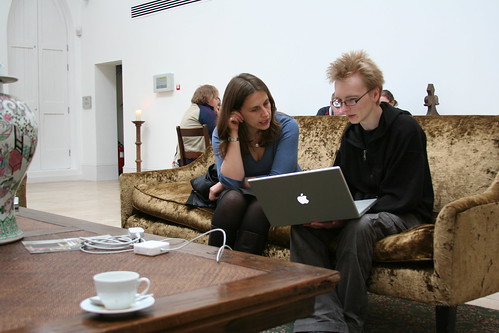
Chris Ivens and Mary Horesh at the last socila medis surgery

When & Where

Next Surgery: Wednesday, June 17th, 2009 drop in anytime between 5.30pm to 7.00pm at Fazeley Studios, 191 Fazeley Street, Digbeth, Birmingham, B5 6DR,  link to map. (not BVSC) It’s opposite the Bond and a go kart track. Push the large pale blue door with the silver door knob.

To sign up please go here.

What are they all about?

Volunteers from the Birmingham bloggers group are offering to show voluntary and community groups in the city how you can make best use of social media. It doesn’t matter if you are the head of communications at a major charity or an active citizen in your neighbourhood, if you’re at all curious come along.

More about what has gone on over the past nine months and what you can expect at a surgery here.

The surgeries have been nominated for the Digital Press Awards People’s Choice along with brilliant local activity like Rhubarb Radio, the Big City Talk site and the 4amproject.

In mean time, if you want to come along or know someone thatcould use the free help get them to sign up here so we have an idea of numbers.

Birmingham Social Media Surgeries – taking stock.

Later this month a group of enthusiasts will get together to run another one of Birmingham’s Social Media Surgeries.  It wasn’t supposed to be like this. The original idea was just one as a practical contribution to Blog Action Day, set up by volunteers and run by volunteers.

So far we’ve done five, (I counted wrong before!)  three at BVSC and Two at Fazeley Studios.  The results:

  • At least 60 people from probably 50 organisations – helped.  That’s based on numbers for 3 surgeries, because for two of them we were so busy we all forgot to record who was there and where they were from.
  • At least 33 volunteer surgeons involved, many of them repeat offenders.  They probably average about 5 hours of effort each, plus the organisers,  means a minimum of 175 hours of high quality, highly skilled voluntary effort.
  • Since that first evening – a number of sites have been set up or emerged. For example:

    Birmingham’s Jubilee Debt Campaign came out of that first night and Audrey and Duncan Miller have kept on using it, because they prefer it to their old site.

    Court Lane Allotments blog popped up shortly after the first surgery.

    Birmingham City University Student’s Union is already planning to develop surgeries of their own, inspired in part by their visit to ours.

    The Digbeth Trust is switching it’s web platforms to use more social media after being helped to appreciate the benefits as a surgery patient on a couple of occasions.

    Some have become serial bloggers:

    City Centre Neighbourhood Forum was set up by Karen and Geoff Caine, spurring Geoff on to create Canal Scene a brilliant combination of a blog with Google maps – (Geoff can you switch comments on for me please!)

    The Ramblers locally is now using this blog to explain how they’re getting people walking in  the city and Mohini, who works for them, has already started a blog about Mangoes!

    Other place based sites pop up.

    Acocks Green Neighbourhood Forum has started with this site and already begun connecting with other very local sites.

    East Yardley Neighbourhood Forum (nearby) has also begun the process of shifting their website onto a more social platform.

    Tony at www.cannonhillpeoplespark.net has been along looking for advice on how else they can use the web whilst John Heaven, from well established Lozells.info, also got some great advice on what they can do next.

    These are just some examples, I’m pretty sure there is stuff I’ve forgotten or don’t know about.

    Some people didn’t want to plunge straight into using social media for a charity, their neighbourhood or work and so we have helped create at least half a dozen personal blogs. Some have fallen silent, others are used with great passion.

    This video helps show how much people enjoy the surgeries, and that they are not always the folk you most expect:

    We don’t expect it to stick first time and we encourage people to come back. When they book for the second time, it is their comments that encourage us.

    They include the very practical: “So useful last time, need a little more help with developing the blog lay out,” and “just a matter of fine tuning my site to send it public” or “thanks to the brilliant advice and support we got last time it inspired us to put our website up (just), and we’ll be along to discuss building on our social support!”.

    Notice the language. These people feel like they own these bits of the web. In the past efforts like this have been more likely to lead to moribund pages on communal portals.

    Sometimes people come back already comfortable with the basics and hungry to understand  more technical aspects of how the social web encourages conversation: We want to “extend our blog skills to improve how we use trackback and linking” or: “placing of images within text. What are pingbacks?”.

    Over time they are encouraged to use video, host images in more social places, perhaps even experiment with twitter.

    Aspirations vary.  Some want to “promote our government funded service to the local community.”  Others “as a fundraiser for this organisation , I really need to know how to use social networking sites, develop a blog for former members and to learn about keeping a website up to date. Not all at once!”

    “Not all at once” is important. The one to one (or almost) surgeries mean that people learn what they need as and when they need it.  It is also less intimidating for anyone to go from learner to teacher, so the number of potential volunteer surgeons grows all the time.

    It ain’t broken really.

    I’ve been thinking of ways to change or improve what we do, but mostly people don’t want us to meddle:

    May 2009 Birmingham Social Media Surgery – feedback from Podnosh on Vimeo.

    To the best of my counting,  so far 33 different people have been volunteer surgeons. Some have been at every event, others have come to one and helped hand out tea.  They are not all from Birmingham, Paul Henderson has come from Warwickshire,  Paul Webster Yorkshire (yes, Yorkshire on 2 evenings) Philip Oakley, Kate Spragg, Kasper Sorensen and Simon Howes wend their way from different spots in the Black Country.

    I am going to try and name everyone, because no blogger will shrink from being thrown a link and each deserves credit and thanks.  Rob Annable, Pete Ashton (the orginator of the surgery concept), Jon Bounds (huge levels of effort) Karen Caine and Geoff Caine (who began as patients, set up a blog then became surgeons).  Abby Corfan, Joanna Geary and Nicky Getgood have helped alongside Julia Gilbert (also a passionate organisational helper), Anthony Herron (I think), Jon Hickman and Neil Houston.  Also on the list, and remember these are all volunteers, is Chris Ivens,  Webby award winner Stef Lewandowski, Andy Mabbett and another learner turned surgeon Leonardo Morgado.

    So more than half way through we can add father John Mostyn and son John Henry Mostyn, then Stuart Parker, Antonio Roberts, Danny Smith and Mark Steadman.  That leaves ‘just’ Chris UnittBenjamin Whitehouse, Simon Whitehouse (another who turned up thinking he was there to learn and has been teaching ever since) and finally (apart from the people I’ve inevitably forgotten) Gavin Wray – charmingly popular with the ladies.

    Diane at Fazeley Studios has worked as a volunteer receptionist for us and Candy Passmore at BVSC gave us immediate and generous help with a venue and  support for the first three surgeries.  Digital Birmingham and Be Birmingham have also given us great support by passing the dates around to their networks and encouraging active citizens to come.

    What do the surgeons have in common?

    As far as I can tell nothing more than a desire to help and a belief that social media can advance community groups and community activity.

    We are also all connected to each other through various online and real world networks formed or nurtured in Birmingham over the last couple of years, some further back than that. Without those networks being both online and real world we may not have got to know each other well enough to be happy to collaborate like this.

    What keeps people coming back to give their time?  My guess is that most found that being a surgeon helped them learn faster and learn more.  They also care about Birmingham as a place. It can be exhilarating.  In fact, it  makes me feel great.

    Why else would we do it?

    Mappa Mercia – Open source mapping for Birmingham

    An open source street map of Birmingham has been completed by volunteers – next they will be turning their attention to the Black Country, unless of course the Ordnance Survey open up it’s data as recommended in the Power of Information Taskforce report.  (Come on OS – save these folk some pixel work.)  I’m also told that the folk who handcrafted every pixel are keen to come to the next Social Media Surgery.
    Below is an entire news release from  www.mappa-mercia.org

    “OpenStreetMap is a free editable map of the whole world. It is made by people like you.”

    PRESS RELEASE FEBRUARY 9th 2009

    Today Birmingham takes another huge step to becoming a digital City. The metropolitan area of Birmingham and its environs within the motorway ring have been completely digitally remapped by its own citizens in a format which is freely editable and available at www.openstreetmap.org.

    It is the first English city to be completely remapped in this way. It joins the likes of Paris, Berlin, Canberra and Vienna

    Birmingham now has a digital map that is more up-to-date and accurate than all other online or satnav maps. Only Ordnance Survey can claim to be more accurate – and they have huge technical and financial resources at their disposal.

    (Click here for a detailed view of Birmingham )

    The OpenStreetMap of Birmingham has been created by local people, with local knowledge, who take pride in how their neighbourhoods are represented. They can match, and even surpass, the efforts of commercial mappers who spend millions creating this kind of rich data. A dedicated band of 100 volunteers has been collecting GPS data whilst cycling, walking, and riding the buses and trains. One of our team has even mapped by canal boat!

    The raw positional data is supplemented by additional visual observations on the ground and then edited into a format that can be rendered as a map readable by humans. All the software used in the project has been developed as open source software and is free to download and use. All participants have to do is invest their time and pay attention to detail. All data once submitted is editable in a wiki-style process.

    “It’s very satisfying to see a complete city mapped in OpenStreetMap. Four years ago when this project was created we were looking at a blank screen and most commentators thought we were crazy.” said Andy Robinson, secretary of the OpenStreetMap Foundation and a prolific mapper in the West Midlands.

    The Birmingham effort is part of a worldwide movement to digitally remap the entire planet which started in 2004. The project was originated in the UK and now involves some 85,000 enthusiasts globally, who have so far mapped almost 14 million miles of road globally. We have mapped some15,000 residential roads, 6,000 footpaths and 9,000 other roads in Birmingham ( and over 700 bus stops, 300 pubs, 200 traffic lights and 300 postboxes)

    Why re-map the world?

    We need a free dataset for programmers, social activists, cartographers, and communities and the like to use geodata and create maps suited to their purposes without being limited by proprietary restrictions designed to protect large corporate investments in geodata. Under-developed countries are particularly helped by a project of this sort, because it is just not economic for commercial mappers to map their areas in detail.

    How can it be accurate? The essence of a wiki-style process is that all users have a stake in having accurate data. If one person puts in inaccurate data, maliciously or accidentally, the other 99.9% of people can check it, fix it, or get rid of it.

    Just think how amazing it was a few years back when you saw Google Maps for the first time. Suddenly mapping was cool, and access via an API* lead to a wave of innovation. Satnav was nowhere 3 years ago. Look at it now! But you still can’t access the incredible amount of data locked behind the API and you can’t add or improve it, so your applications are limited. Just think of the explosion of innovation, much of it in unexpected areas, that’s possible when the data is available!

    All the software used in the project has been developed as opensource software and is free to download and use. The data and maps are licensed by Creative Commons which defines the spectrum of possibilities between full copyright — all rights reserved — and the public domain — no rights reserved. What this means to users (and this isn’t legal advice) is basically you can do what you like with the data, so long as you mention the original creator and the licence and anyone else can do the same with anything you produce.

    A flagship example of the power of opening up access to geodata is OpenCycleMap.

    It’s a customised online map for cyclists, based on OpenStreetMap data. It shows things that are interesting to cyclists including signed cycle routes, offroad cycle paths, bike shops and bike parking – and of course hills – whilst diminishing other things like motorways that are of little interest. It’s built on top of OpenStreetMap, and was recently commended by the British Cartographic Society.

    So we’ve got a map, what’s next?

    1. There’s most of the Black Country to map for a start!

    2. Local businesses and organisations can start using OSM maps and data, rather than proprietary sources, freeing themselves from the technical, financial and accuracy restrictions of commercial mapping providers.

    3. Now that we have a complete set of local data, Midlands software developers can start using it to create novel applications (e.g road traffic simulations, tourist trails, restaurant guides).

    Why would a business consider using OpenStreetMap data when anyone can use maps from Google, Mapquest or Yahoo for free? Put succinctly: they have control. OSM data and map users have significantly more control over their maps than someone who uses a free API. With OSM you can modify, supplement and select the data to create a highly customised map.

    4. It might take a 100 people to produce a map like this but we need a 1,000 to keep it up to date. We need communities and individuals to improve and verify the map via a simple tool available at http://openstreetbugs.appspot.com/ (or on our local West Midlands site http://www.mappa-mercia.org/openstreetbugs.shtml ) All they need is local knowledge and access to the internet.

    For more information, individuals and community organisations can contact Brian Prangle 0121 604 1141 and community@mappa-mercia.org

    Press contact Andy Robinson Tel No 07775537872 and press@mappa-mercia.org

    More information for editors can be found at:

    www.openstreetfoundation.org

    http://wiki.openstreetmap.org/wiki/Main_Page

    www.openstreetmap.org.

    www.opencyclemap.org/

    Images of one year of edits for the whole planet:

    http://www.flickr.com/photos/peterito/3054501076/in/pool-itomedia

    Animation of all the edits we have for Birmingham showing progress from initiation to today:

    http://blip.tv/file/1625650

    We have gathered all the resources together in a specific West Midlands website:

    www.mappa-mercia.org