Category: Neighbourhoods

Internet in a church – the first Yardley Social Media Surgery

Yardley social media surgery

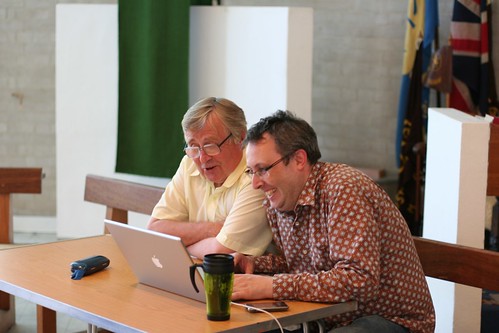
We’ve just ticked off another historic landmark in the development of social media surgeries, with our first Be Birmingham-funded Yardley social media surgery, which I’m pretty sure is the first to be held in a church – St Michael and All Angels.

After a few tricky moments with Wifi (something I’m reluctantly becoming something of an expert in) we were able to impart some help to the church itself, which through Anne Maddox and Mark Hayward is now running its own blog. As you can see from from the post that was put up on the day of the surgery, there are already a lot of interesting things going on with the blog!

Mark has been in charge of the existing church website and is now, thanks to some help from Nick Booth, equipped to use the blog, add pictures and start to explore the benefits this new approach can bring to the community work the church is involved in.

Yardley social media surgery

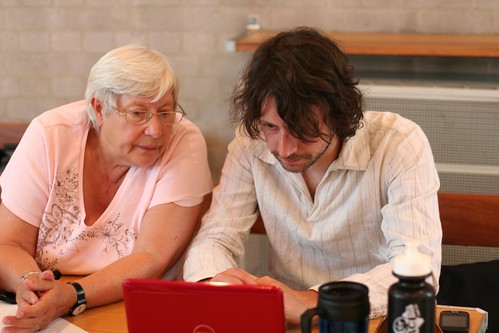
Mark wasn’t the only person getting help, though. Dan Davies also helped Louise Darwood, who lives in Yardley, with help in setting up a blog and using Twitter.

In the video Louise – who is involved with the Riverside Church in Moseley – explains that she is very interested in becoming more involved in campaigns in her local area and hopes the blogging and using Twitter may allow her to develop her interests further.

This is just the first of our Be Birmingham-funded surgeries in Yardley. There’ll be two more – on June 23 and on July 28 – to look forward to, if you’re interested. And, if you want to find out more about what happened at the surgery, you can read my Surgery Manager’s report on the Social Media Surgery Plus website, here.

"Is that on google or the internet?"

Thursday saw me leading a lunchtime session on social media for people who work at Advantage West Midlands.   I’d been invited by the Prospect Trade Union as part of the National Learning at Work Week.

It wasn’t my normal audience – that would be communicators, policy makers, senior officers, politicians perhaps data people. This group just had a lunchtime spare with a mind to learn something new. Curious and hungry and unaware they were about to receive the full bore of my enthusiasm for the web and civic engagement.

Questions questions

Loads of question followed – good simple straight forward ones about how things work, privacy, why you would bother.  The sort of questions we’re used to being asked at social media surgeries.   So a group refreshingly happy to ask the basics.

One really made me stop and think: “Is that on Google or the internet?”.

I was stumped for a moment.  It felt like a cartoon character has just looked up at me from a drawing and asked me to explain the world of 3 dimensions.

It’s a perfectly reasonable one mind (all questions are).  “You can find it through Google or you can go straight to the web page using the web address,”  I tried to explain, adding:  “they’re  all on the internet” to a rather puzzled frown.

It happened to be Silver Surfers this week.   I’m not keen on the idea myself but marketing minds often feel it is working and perhaps that question explains the need.

Remember the basics

If even the concept of the world wide web is still slippery for some (hence the question) how do we describe this fundamental shift in information and relationships for those who have yet to grasp it?   So I asked twitter this question:

I’m struggling for an analogy to explain the Internet to people who’ve only ever known libraries and radio etc.  any thoughts?

and these are your generous answers in the order they arrived:

parboo it’s like a library, all on… Nope, I can see why you’re struggling 😉 how’s you n yours?  (fine thanks)  ( click here for parboo’s blog)

citizensheep I’m struggling to have any thoughts at all at the moment. I’ll have a think though.  (Citizensheep is Michael Grimes and his blog shows that it’s always worth waiting for his thoughts)

josiefraser @podnosh Internet like a highway apparently http://u.nu/3dvfa if you say super highway it makes it a bit more ziggy stardust. So maybe don’t.  ( Josie’s blog)

steve_nicholls @podnosh i think @parboo was on to it there. A big reference book where instead of skimming the index, you type it in?

pauljonlevy @podnosh Like ceefax but better? You off timetravelng? LIke everybook or radio programme in the world on air at the same time?

bounder @podnosh CB Radio with librarians 😉 ?  (Jon’s blog)

redmamba @podnosh brain ?

cyberdoyle @podnosh tell them its libraries and radio on rocket fuel. similar but faster. and on tap. available on demand. if you can get a connection.

peteashton @podnosh probably no help but it’s both larger and smaller than a library. 😉 (Pete’s blog)

natashacarlish @podnosh it’s like all the books and all the radio and a whole lot more inside a tvscreen which you can access all the time

danslee @podnosh Internet? It’s like having a selection of really good books delivered to your desk. At the click of a button #librarywebanalogy (some of the stuff Dan blogs about)

red_annie @podnosh the Internet is what happened when the library, supermarket, post office, radio and tv got squished into a portable box.  (Annie’s blog)

katehughes @podnosh imagine a library so big it has all the books in the world, then imagine that instead of books, it is filled with knowledge, then imagine instead of aisles and the dewey decimal system, the information comes to you instantly and every piece of infinite information is attached to each other so you can find whatever you want from wherever you start. I love the internet. http://tl.gd/1e1lo5 (By the way Kate is cheating – she uses tweetlonger to share more than 140 characters with us!  She’s also blogs at http://socialhousingcomms.blogspot.com/.)

KazThomas @podnosh  Internet:  Encyclopedia of life filled with screens of knowledge!  I reckon that sums it up? (Karen’s blog)

BostinBloke @podnosh electronic library

parboo @steve_nicholls @podnosh yes… and it finds stuff quicker than a quick thing in a quick box and it talks too and you can put stuff in it.

One I left out of order was this:

mattbuck_hack @parboo @podnosh Is the ‘answer’ us? 😉  #copyright #gnomic #utterancesINC

I do wonder whether reading this would make the person who asked the question any the wiser but is amuses me that the tweet that most seemed to sum up my inadequate thought (which is nothing more complicated than “help”) should come from Matt Buck – a cartoonist, one who more than most might be able to explain the transition from 2 dimensions to 3.
London’s Digital Neighbourhoods study published

The talented combo of Hugh Flouch and Kevin Harris from Networked Neighbourhoods have published the beginings of their  research for London Council’s on very local online media.  At this stage (there’s more to come) it comes in two parts:  A list of the types of sites found in London, how they work, who they reach and what they are for .  They offer 8:

  1. Civil Social Networks, such as Haringay Online or Alum Rock Neighbourhood (a bit quiet)
  2. Local Discussion sites, such as forum’s for a neighbourhood, like Balsall Heath Online.
  3. Placeblogs – like Kings Cross Environment or Pit n Pots (these sites are very focused on holding power to account for a place)
  4. Blogazines – are like placeblogs but less focussed on holding power to account – example might include
  5. Public Social Spaces – these are areas created on facebook etc to bring together local material
  6. Local action groups online – specific local pressure orgs using the web, one like Greener Leith are both focussed on an issue and a neighbourhood.
  7. Local Digital News (commercial)
  8. Multiples and listings sites (these are big sites that present information locally too)

Interesting way to divide things up.   As I’m certain Hugh and Kevin know many sites are many things.  Ventnor Blog is a  placeblog, a blogazine and a forum at the very least – probably also Local Digital News.

There are also other forms of local media – most of which come in the shape of tools.  Postcode search on google maps,  fix my street is clearly a local site and often Help Me Investigate is a contributor to the local digital environment in a number of places.

Likewise the combination of a placeblog or two, blogazines, a local listing and the input from local online campaigns forms a more realistic understand of what loal digital media is in any one place.

Of course Hugh and Kevin get this:

As our research review indicates, there have been very few studies of specific local sites and the movement barely registers in the local government world. Many sites are growing and changing rapidly. It follows that any classification has to be subject to ongoing revision.

It is good to see the structure helping people understand that his is not neccesarily a substitute for mainstream media, more a movement with it’s own cahracteristics.  So, as the start of a means for prevailing structures to picture and understand local online activity, this break down is a great help.

Their other report on the research context is a really useful overview of what has already been written avout the net, localness and civic action – reminding us that the web as been at this for as long as we’ve been using the web.  I applus thei conclusion

In our view, the area where we should look for impact is in conversational democracy and the mundane politics of the everyday, and how this is converted into civic action. It would be a mistake to expect impact in terms of conventional political processes.

I find myself repeatedly urging local authorities not to think of the web as a way to get more people to engage with their structures and meetings, but as a new opportunity to find other ways to get involved with the people who care about the places where they live.