Category: Government

Iraq, Clay Shirky, Court Reporting, Post Codes API. My links July 5th through July 10th

These are some of the things I’ve been reading recently:

  • Ernest Marples’ Postcode Latitude/Longitude Lookup API – Post codes are really useful, but the powers that be keep them closed unless you have loads of money to pay for them. Which makes it hard to build useful websites (and that makes Ernest sad). So we are setting them free and using them to run PlanningAlerts.com and Jobcentre Pro Plus. We’re doing the same as everyone’s being doing for years, but just being open about it.
  • PA ‘public service reporting’ pilot set for launch | Media | guardian.co.uk – “The Press Association is to launch a “public service reporting” pilot project later in the year aimed at replacing the dwindling news coverage given to meetings of public bodies in the local and regional press” hen I started in journalism this was core, not a peripheral part of the job.
  • Living with rats – Nobody has heard of Clay Shirky – “Out of around 40 council officers there, four had heard of the Digital Britain report. Three had heard of Charlie Leadbeater, one of the keynote speakers at Monday’s bash. As for Clay Shirky, author of Here Comes Everybody and every aspiring social media guru’s guru, he drew a blank. (There’s a link to one of his talks here, if you’re interested).”
  • 100 hours this summer – “Here’s my challenge. Right now, put aside 100 hours over this summer. Do it right now, in your head. Put that time aside. 100 hours. 8 hours a week for the next 12 weeks. One hour a day, or one working day a week. It’s one summer out of your entire life, it’s nothing. Okay, you’ve got that 100 hours? Now for the next two days, go to talks and start conversations with people you don’t know, and choose what to spend your 100 hours on. I guarantee that everyone in this room can produce something or has some special skill, and maybe they’re not even aware of it.”
  • The Generation M Manifesto – Umair Haque – HarvardBusiness.org – “You sacrificed the meaningful for the material: you sold out the very things that made us great for trivial gewgaws, trinkets, and gadgets. We’re not for sale: we’re learning to once again do what is meaningful. There’s a tectonic shift rocking the social, political, and economic landscape. The last two points above are what express it most concisely. I hate labels, but I’m going to employ a flawed, imperfect one: Generation “M.” What do the “M”s in Generation M stand for? The first is for a movement. It’s a little bit about age — but mostly about a growing number of people who are acting very differently. They are doing meaningful stuff that matters the most. Those are the second, third, and fourth “M”s.”
  • Will Perrin : An open, digital Iraq inquiry: “The inquiry should assume that interesting things will be done with the information they publish off their website by independents.” A really thorough explanation from Will Perrin about how the UK Government Iraq Enquiry could use the web and meta data in important ways.
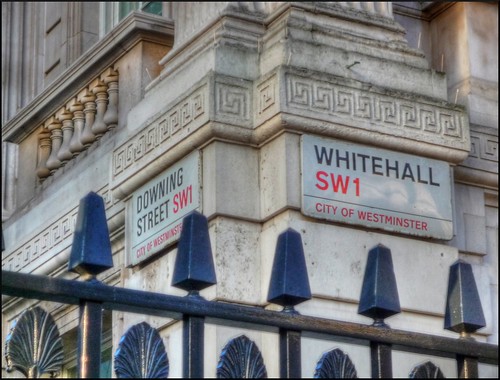
Blackhall is the new Whitehall – rapid development of government policy.

Whitehall by Rick Lewis on Flickr - click to see original

Will Perrin has a knack of helping people understand how the web is changing government. Today he publishes what was until now a private paper on how Whitehall can be transformed.

In Transforming the way we work – from Whitehall to Blackhall he writes about an alternative Whitehall, one that embraces how the web can accelerate change:

The leaders of Blackhall have changed a predominantly ‘need to know’ culture to one underpinned by a ‘need to share’.  They have begun to change the business model from a paper process base to a knowledge based model.   There is far more permeability in Blackhall between government Departments, the wider public sector, the third sector, stakeholders, citizens and business. Policy formation in Blackhall takes weeks or months, rather than months or years, involving more people to create better outcomes with less effort. Officials share knowledge with others across government and with those outside government such as the third sector, font line workers and managers. This is enabled by a pervasive Blackhall electronic working environment. Officials publish information from their screens that can be read by anyone connected to the GSI and selected people outside it, without using email.  The majority of work in Blackhall is published internally so that colleagues can find it using search in the same way they google for information on the internet. A Blackhall working environment would be electronic, pervasive, accessible from wherever you are in the UK and in many cases overseas.  Implicit in this is a standard ability to work on the move with any laptop, blackberry or internet connection.

He continues with what needs to change.

The difference between Whitehall and Blackhall is a managerial determination to make it happen. It might sound difficult to get a multi-hundred year old monopoly to change.  But the civil servants themselves are changing outside the workplace as they use Easyjet, Gmail, Facebook and instant messaging in their private lives.  When they get to work they slip back into an earlier era because the tools aren’t there.

These are his slides from the presentation he gave of these ideas a year ago.

They include compelling illustrations of how little Whitehall has changed communication conventions, regardless of changes in technology. How much is this like the place where you work?  How easy will it be to change from Whitehall to Blackhall.

Derbyshire County Council elections – a social media experiment.

Above is Sarah Lay from Derbyshire County Council talking about her recent experience of using social media to tell the story of  the council elections of 4th June 2009.  As SOCITM the organisations which represents the folk who run council websites, puts it:

County Councils saw their web traffic double last Friday and Saturday thanks to their provision of a sophisticated online election results service coupled with use of social media tools like Twitter, Facebook, RSS feeds and email alerts.

Sarah describes how the council announced the results straight onto twitter (followers trebled), plus offering an election map and a virtual council chamber.  They also used a Facebook fan page (yes 74 people claimed themselves fans of a local election) where people were able to have their own conversation about the results.

In effect they by-passed mainstream media.   This system treats journalists just the same as any other citizen, offering us all the same information at the same time and space to talk about it.   However this is also good news for journalism, because it allows the professionals to spend increasingly precious time checking for truth and getting to the bottom of the implications of the election, rather than simply shoveling fact.

Sarah has written in much more detail on her own blog.  In the first of two posts, on election day itself, she wrote with great passion about preparations:

All of this has been going on for a number of months (not full time) and has been a learning curve and exciting project for this team to get into. For the first time we have had a significant presence internally in promoting and reporting on elections. It’s provided an opportunity for us to raise awareness of our work internally and work with colleagues in other departments to enable everything to happen.
Our results system will hopefully be the jewel in the crown of what we’ve done so far. We won’t know until the dust settles tomorrow and we have some feedback from Derbyshire voters, councillors, other officers and colleagues in the public sector who are kind enough to take the time to have a look.

After the elections she said:

I am still a little emotionally charged from the adrenalin of working at such pressure yesterday and giddy with the joy of how well our team worked together on the day and in the run up. Now we just need to decide what to tackle next!

Simon Wakeman at Medway Council was one of a number of people who gave support and encouragement to Derbyshire and other councils embarking on this path. He has written about how a variety of local authorities used the social web on election night.  Also on Sarah’s list of supporters was Al Smith in Newcastle.

All the above was recorded at the truly wonderful localgovcamp, held here at Fazeley Studios in Brum

Why it's great that Tim Berners-Lee is advising the British Government.

The announcement that Sir Tim Berners-Lee will be advising the UK Government is important not because he invented the world wide web, it’s not even because he’s very clever, and so credible he’s hard to ignore.

It’s simple because he’s really is obsessed with data. I know that seems like statement of the bleedin’ obvious but its worth saying.  This is good news because he really does know what he’s talking about. If you want to appreciate how much he cares, watch this TED.com talk from February 2009:


In it he talks about his concept of Linked Data, which asks for 3 things:

  1. Individual bits of data should also be given web addresses, that’s an address beginning with http for every bit of data within another document: people, places, events, products, genes, chemicals etc etc.
  2. That data appears in some sort of useful protocol.
  3. When we get the information it also contains relationships –  and whenever it expresses a relationship, the thing it relates too also has an address starting with http.

So Tim Berners-Lee cares about much more than the mechanics of how we move to HTML 5 (the new rules for how we will work the www).  He cares about how data can make government more transparent and help knowledge evolve faster.  His role will include (hat tip to Tom Scott):

  1. overseeing the creation of a single online point of access and work with departments to make this part of their routine operations.
  2. helping to select and implement common standards for the release of public data
  3. developing Crown Copyright and ‘Crown Commons’ licenses and extending these to the wider public sector
  4. driving the use of the internet to improve consultation processes.
  5. working with the Government to engage with the leading experts internationally working on public data and standards

He also believes in the power of grassroots movements. That’s Us.  As he puts it in the talk:

I asked people to put their documents on this web thing, and you did!  Thanks.  It’s been a blast.

He understands that the remarkable thing about the internet is we built it.  It flourishes because we choose to share stuff with each other using the rules he created back in the late 80’s and early 90’s.

So a world wide web of Linked Data is not something he expects big commerce or big government to take sole responsibility for. He expects us to learn how to do it, just as every time we add something to Facebook we show that we have learnt how to play our part in making the World Wide Web.

You might also want to listen to this interview with Rory Cellan-Jones, about the problems of bureacracy. Emma Mulqueeny thinks his reputation will bring much needed “serious intervention” to a data muddle, while Paul Canning echoes that, hoping that (with the departure of Tom Watson from the Cabinet Office) Sir Tim might be able to act as a data head-banger.