Year: 2009

Who are the G20Voice bloggers – a list

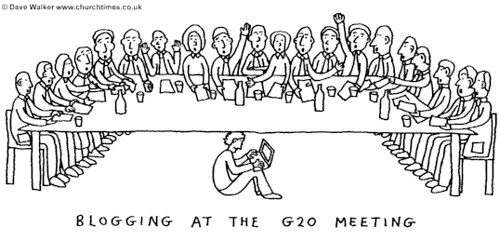
Dave Walker of Church Times created this original drawing.

Who are the G20 bloggers (?) I hear you ask.   Here’s a simple list of our sites:

Daniel Kaufman  www.thekaufmannpost.net

Ahmed Al-Omran  http://saudijeans.org

Sokari Ekine  www.blacklooks.org

Simon Berry  www.colalife.org/blog/

Richard Murphy www.taxresearch.org.uk

Dave Walker Cartoonist

Jessica Uribe Salinas   vivirmexico.com

Jotman (writes anonymously)  http://jotman.blogspot.com/

Duncan Green www.oxfamblogs.org/fp2p/

Simon Todd www.climatecafe.org/blog

Vikki Chowney tech.bitchbuzz.com/

Cheryl Conte www.jackandjillpolitics.com/

Rodrigo Alvares  www.novacorja.org/

Daudi Were www.mentalacrobatics.com/think/

Dr Kumi Naidoo www.huffingtonpost.com/kumi-naidoo

James Simmonds www.sendmyfriend.org/news/young-campaigners

Sunball Hussain  www.myplatform2blogs.com/info/myplatform2

Joe Rowley  www.myplatform2blogs.com/info/myplatform2

Rowan Davies www.mumsnet.com

Virgina Simmons http://one.org/blog/

Michael Kleinmann http://humanitarianrelief.change.org/

Nick Booth http://podnosh.com/blog

Rui Chenggang http://blog.sina.com.cn/ruichenggang

Faik Uyanik   www.faikuyanik.com

Nacho Escolar www.escolar.net

Carole Edrich http://www.flickr.com/photos/webwandering

Richard Murphy www.taxresearch.org.uk

Alex Evans www.globaldashboard.org/

Kady O’Malley www.macleans.ca/itq

Montserrat Nicolas http://curvaspoliticas.blogspot.com/

Anthony Painter www.e8voice.blogspot.com/

Lloyd Davis www.perfectpath.co.uk/

Diana Vogtel www.350.org

Cédric Kalonji  www.congoblog.net/

Lani C. Villanueva

Also blogging with us is

Tom Watson www.tom-watson.co.uk

If I’ve missed any of you please shout.

Stuff I've seen March 29th through March 31st

These are my links for March 29th through March 31st:

  • The fundamental media bias | The Democratic Society – " “narrative bias” – the fact that newspapers favour reportage that create narratives over stories that are factual. The strong narrative line is that we’re in a uniformly disastrous situation, and the PM, or Obama, or whoever, can personally shift the global economy for good or ill. The weak narrative line – as ever – is that it’s very complicated and hard to read the signs "
  • The power of serendipitous findability and the end of bullshit – "Why am I more optimistic now than at any time in my life? Because I think we’ve never had such good small-group making tools or such good information-connecting tools. We’re developing a global social nervous system. As a result, I think bull-shit is in trouble.
    And it’s all because of serendipitous findability—the odds that you will fortuitously connect with someone you don’t know but share an interest with, or the odds that you will learn something timely or surprising or valuable to you."
  • Matt Lock Commissioning for Attention Part 1 – Read Me! « TEST – "‘commissioning for attention’, a phrase I’ve been using for a while to describe what I do at Channel 4 Education. I hate phrases like ‘360 content’ or ‘multiplatform’, as these encourage people to get hung up on technology or to have a box-ticking mentality to where ideas can exist, rather than really focusing on users and understanding what they’re doing."
  • Wirearchy · Hierarchy is a Prosthesis for Trust … – Just to quite: :We are increasingly using attraction and negotiation to arrive at what needs doing, by whom, for when and with what. Many (but certainly not all) areas of economic and societal activity still operate with traditional hierarchy, and more and more often the trust it offered or symbolised is being betrayed in order to serve the interests of those who hold the power. History suggests that 1) it has ever been thus, but / and that 2) when practiced to excess, dire consequences eventuate."
  • Ten Tips For Creating a 21st–Century Classroom Experience – Tessy Britton writes about David Barrie's ideas on what would create a great classroom experience, including:

    "2. Create from relevance. Engage kids in ways that have relevance to them, and you’ll capture their attention and imagination. Allow them to experience the concepts you’re teaching firsthand, and then discuss them (or, better yet, work to address them!) instead of relying on explanation alone.
    3. Stop calling them “soft” skills. Talents such as creativity, collaboration, communication, empathy, and adaptability are not just nice to have; they’re the core capabilities of a 21st-century global economy facing complex challenges.""

    Great read

“Can we talk?” – a new measure for liveable cities.

I’ve been asked by MADE to write 200 words for the Birmingham Post. They’re gauging opinion before the Technical and Environmental  Mayor of Copenhagen speaks in Birmingham next week. Klaus Bondam will be at Town Hall on April 6th to share with us how he expects Copenhagen to stays a wonderful place to live.

I was asked about an hour ago and the deadline is tonight.  Here’s a bashed out draft of what I fancy saying. Please encourage, discourage amend etc in the comments. Does anyone have details of that survey that put us the 2nd best place for social media behind, is it Chicago?

————————————————————————–

Is this a good place to talk?  It’s not a question we often ask about cities.  After all the whole point of a city is that we can connect, trade and work.  Non of that happens without talk, does it? No it doesn’t, and neither does innovation.

Conversation is about scale, it happens where it’s easy for people to gather in small groups.  The ICC is evidence that we know about audience on a grand scale, but how well do we do small scale gathering?

We need many places where we can meet, deliberately or by accident.  That means a city which is easy to walking but above all has many interesting and modestly scaled places that people want to go.   It means a tolerance of other’s ideas and interests, a city where people also like to listen.

These are partly planning issues and partly cultural issues. How good are our public services at setting the example and being interested in us, how good our our planners and designers at encouraging the interesting?

And of course we don’t just want to talk to ourselves. Birmingham needs take part in a global conversation.  So our schools need open access to the internet and our school teachers and pupils helped to have the confidence to take part in sharing and developing ideas with people across the planet.

Oh and Birmingham doesn’t have free internet access in the city centre, whatever our PR folk may so. So Birmingham Fizz needs to be turned of or turned into a proper free wifi service, so we can finally start hearing each other speak.

Well?