Archive for February, 2009

Social Actions Wordpress plugin.

Written on February 25th, 2009 by Nick Booth

1 Comment

I love the idea behind this Wordpress plugin from Social Action. It makes me think of Paul Bradshaw’s 2007 5w and an H idea for news organisations.  The plugin is described as:

Related Ways to Take Action” enables you to share ways to take action based on the stuff you’re already writing about.

The WordPress plugin works by scanning each of your posts for the top three keywords and then searches for related actions from Change.org, GlobalGiving.com, Idealist.org, DonorsChoose.org, Kiva, Care2 and over twenty other Social Action Platforms. It then automatically loads the top three campaigns for those keywords at the bottom of each of your posts.

There are also extra customization features for enabling (or blocking) certain keywords, choosing platforms, and choosing action types.

Related Ways to Take Action” makes it super easy to activate your WordPress blog for social change by sharing related campaigns, petitions, fundable projects, and more ways your readers can make a difference based on your blog content.

The “Related Ways to Take Action” WordPress Plugin is a project of Social Actions Labs and was developed by Eric Cooper.

Thanks to Alice Casey for spotting this one.
Animation for Mobile Technology: Birmingham Event.

Written on February 25th, 2009 by Nick Booth

Comment here

I’ll just quote this press release including very bold use of the words spectacular (fireworks?) and unparalleled:

On 4th March, Animation Forum WM and LUCID are hosting a spectacular evening to explore the unparalleled new possibilities that stem from animating for mobile technology. The event, When Animation Goes Mobile! is free to attend and will take place at The Telford Room, Austin Court, Brindley Place, Birmingham (B1 2NP). It will start at 7.30pm on Wednesday 4th March 2009, include a break for complimentary wine and nibbles, and be followed by a Q&A with the speakers Madevi Dailly and Richard Morris. Animation Director and Producer Madevi Dailly will take animators through the practicalities of animating for mobiles, and the potential for linking mobile animation to external factors, such as the surrounding environment or the time. Here’s a short she created for 4mations last year (warning, contains strong language): Madevi will be followed by Richard Morris, Director of Video & TV at mobile animation distributors PlayerX, who will take everyone through the strategic side of mobile animation, outlining how your studio could blossom in the mobile animation market. To attend, simply RSVP to david.luke.allen@bcu.ac.uk with ‘When Animation Goes Mobile!’ in the subject title as soon as possible.

Enjoy.

Microsoft loses £258,000. Why? It seems Walsall Council is going open source as it trims budget.

Written on February 23rd, 2009 by Nick Booth

13 Comments

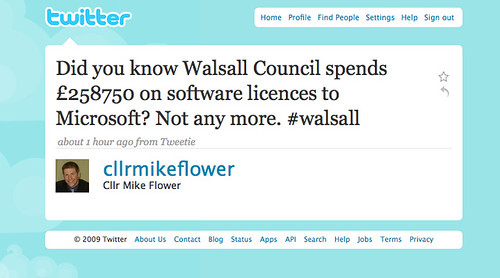
Walsall Councillor Mike Flower has been tweeting from the budget setting meeting of Walsall Council. A while back he popped up one saying the council will stop paying Microsoft £258,750 for software licenses:

tweet from Mike Flower

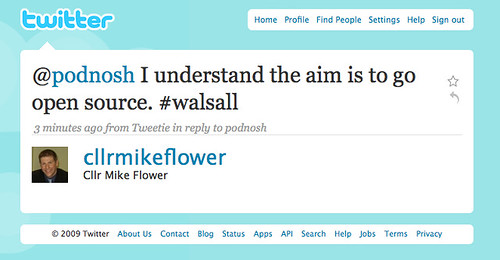
How, I enquired, by going open source?  Yes, he thinks:

tweet from Mike Flower

Thanks for reporting for us from the council meeting. Very interesting. Have they budgeted for some re-training, or are they confident that the transition can simple be made. Any one from Walsall Council willing to flesh things out please do so below:

Links: Mission Impossible, Drift and Steve Jobs.

Written on February 22nd, 2009 by Nick Booth

Comment here

Neil Williams with a refreshing take on the new Digital Engagment Tsar’s job description: “So no pressure then. It’s truly a cracking job ad, targeting the challenges faced by government’s digital pioneers with a laser-like precision.”

Drift. Nikki Pugh walk’s Digbeth to discover that GPS is a bit cronky: “As I walked, I noticed that the device in my right hand was consistently giving me more erratic readings for my position than the one in my left hand. At one point I left them both next to each other on a wall for a few minutes so that when I could tell if it was my body disrupting the signal, or if it was because the device in my right hand was closer to the buildings I was walking past.”

Melanie Hayes clarifies how 4iP ought not be as clear cut as critics (see comments here) argue: “I don’t want to encourage a box-ticking approach to submitting ideas to 4iP; we want ideas that reflect the spirit of our investment criteria not simply a list that tells us what you think we want to hear.  Such an approach would never succeed anyway because it ignores the more intangible element of our process which is the exercise of professional judgement by a team that has been purposefully selected because of their diverse range of views, skills and expertise.”

Anecdote on the power of hobbies for building communities.  “I noticed an animated discussion between two of the engineers talking about their love for motor bikes. They’d worked out they both had an interest in German classics and one was describing a fuel tank issue he was having. You could see that there was trust and respect in the conversation and this trust and respect was at least partially developed while discussing their hobby.”

Steve Jobs Logs Off?   Jack Schofield reporting claims that Steve Jobs is not online. He adds a very useful reminder for any of us online: “I suggest you heed the immortal words of Shirdi Sai Baba: “Before you speak, ask yourself: Is it kind, is it true, is it necessary, does it improve upon the silence?”

Links: Downing Tweet, Potlatch, Play.

Written on February 22nd, 2009 by Nick Booth

2 Comments

Charles Leadbeater on the Digital Britain report. “To succeed, according to Perez’s theory, the government’s plans for broadband would only succeed if they also bring about a massive change in consumer habits and lifestyles, which new businesses can make a profit from. When her theory is boiled down it turns into three questions about the government’s plans set out in Digital
Britain. Will the technology really deliver? Will enough consumers want it and create new demand with it? Can businesses innovate to supply new services that a mass of consumers want which will be profitable?”  (hat tip Dave Briggs)
Downing Street Hits a 100,000 Twitter followers: Simon at Puffbox says: “The fact it may not be here tomorrow shouldn’t stop us exploiting it while it’s there. 100,000 people have signed up – actively, voluntarily – to hear from the heart of UK government. Now they’re actually listening, what should we be saying to them?”

OOGL:   “Shortly after President Obama’s inauguration, he issued a memo on transparency directing his top officials to develop plans for an Open Government Directive to promote transparency, participation, and collaboration. The Sunlight Foundation has created this page in order to add a public element to the crafting of this Open Government Directive that is itself transparent, participatory, and collaborative”

Jon Hickman asking questions of 4iP (and getting answers) “One might say that the shine has come off, and some people have become critical of what seemed originally to be a good idea.  So what has gone wrong?”

A revamp in Prospect.

Potlatch on Play:  “I have a new metaphor for the next stage of post-industrial capitalism: the play-ground. Where play happens, but there is also an audience.* So how does our playground society produce economic value? Well, of course it produces value for those at play, who enjoy the scurrying around, socialising and innovating. But how might it produce business value? Most of the time, it will still be via the monitoring, watching, evaluating. What play produces is mostly of little interest to our corporate parents. Except, consider the exception. Parents still retain and cherish the paintings that their small children produce, and stick them up on their walls. Childish play still has its totemic products that are valued and endure. This, then, is the metaphor for user-generated innovation in the eyes of corporations: the innocent, messy artwork produced at playtime, that can be held up as proof that things aren’t all top-down”.

Every Voice Counts West Midlands:  “Empowerment is the result of strategic and practical actions – such as engagement, participation and partnership working – that increases the capacity of people to influence the decisions that affect their lives. A National Empowerment Partnership has been created to support and inform the Government in achieving this vision across the English regions.” Umh.

Social Media and chalk.

Written on February 21st, 2009 by Nick Booth

Comment here

York art gallery

Abby Corfan from Audiences Central explains very neatly how social media is not about technology:

I strongly believe that social media doesn’t need to rely on super shiny gadgets or fancy websites- in fact it’s so much more about the ‘social’ part than the ‘media’.

Which leads me to this example: At York City Art Gallery they recently invited people to comment and write messages under works of art using blackboard and chalk. It was for an exhibition curated by Tracy Chevalier (author of Girl with a Pearl Earring) who chose pieces from the gallery’s collection which depicted parts of stories. These were hung with a blackboard border and gallery attenders were invited to write suggestions for the beginning and ends of those stories around the artworks. This is not a new technology, but it is an application of the principles of sharing, commenting and engaging in a dialogue; which to me is exactly what social media is for.

Agreed.

Which council workers would not benefit from using social media?

Written on February 19th, 2009 by Nick Booth

20 Comments

Foo

Question:   Are there council jobs which would not benefit from what social media types know?

Answers below please.

Image Gavin Anderson.

Links: A Call to Farms, meaningless involvement, Doodle for Google, Obama on internet transparency and LINKS

Written on February 19th, 2009 by Nick Booth

Comment here

David Barrie writes this wonderful post about alternative US Midwestern culture, social media, government and social inclusion.

A Call to Farms is one of the best books I’ve read so far this year. It’s a series of essays linked to a journey that a group of people took in 2008 through Illinois and Wisconsin in search of the Radical Midwest: places, people, community groups, artists, social activists who offer alternatives to “business as usual” in the land of corn and greed. (You’ll find the project blog here; and the Midwest Draft Flickr pool here.”

Is Local Always Better? asks Rob Greenland, as he considers the Conservative’s new take on Local Government:

“If a decision is taken in a way that makes it difficult for you to have a meaningful involvement, it doesn’t matter whether that decision is taken 2 miles or 200 miles from your house.  I think a more fundamental rethink of how we make decisions about local priorities is required.   I don’t have the solution, but a celebrity mayor and a few more bureaucrats moving in down the road won’t solve things on their own.”

My earlier quick thinking was the proposals are not local enough.

Google Doodle

Doodle for Google: Above Dan Rowe’s take on his community in Cornwall:

G: A surfer on a wave. O: The cornish flag. O: An ice cream. G: King Arthur’s sword in the stone. L: A cornish tin mine chimney. E: A man eating a traditional cornish pasty”

Hat tip Steel&Stevens and Lauren.

Watch this (courtesy of Paul Canning)

YouTube Preview Image

and always remember what Billt says.

Key Questions: Local Government and Social Media

Written on February 18th, 2009 by Nick Booth

3 Comments

What this blog post says.

Ingrid Koehler at the IDeA Srategy Unit poses seven good questions. Here are my thoughts, although they boil don’t to one key answer:  Get involved and act like normal people do.

1 What are the greatest areas of potential benefit in councils using social media. These spring from the culture change which social media can help to drive, or rather requires you to adopt. Organisations which are alive to how social media can build trust, strengthen relationships and allow people to collaborate will eventually benefit from being able to work much better with the people they are there to serve. It helps make you a council which learns quickly, acts quickly, collaborates well inside and outside the organisation, is transparent and more trusted.

2 How can councils support individuals in becoming digitally enabled and empowered?  I think the answer is to start with your own staff. Councils employ a goodly proportion of those in work in any area and if they get it then that will reach many others. Give them access to organised yet informal help on how to use social media for their work. Reward those who share what they know and make sure they know they have permission to help the ‘citizen’ to also learn how to use the social web. Why doesn’t a housing repair team use social media to talk about what they do – why can’t they then share these skills with the people they meet in their work? Support would include identifying digital mentors in your teams and offering social media surgeries, some for insiders, some for outsiders and some for both. Don’t underestimate how much people enjoy using the social web and treat that as an opportunity.  Oh, and open up internet access to council staff.

3 How can local and hyper-local social networks increase community cohesion and empowerment.  At it’s simplest these networks help people know each other. That in turn allows them to see what they have in common and to begin to organise around shared problems or opportunties. Don’t imagine that a council run ning for each neighbourhood is the answer though.  Often councils have to go to where networks have begun to spring up. Don’t expect people to come to you. Equaly don’t think of these online very local networks (they could cluster around a blog or series of blogs, perhaps even people on twitter) are separate from you as a local authority. Just be sincerely part of them.

4 How can councillors develop their leader and communication skills using social media?  The key here is not the tools but the habits. If they participate in the conversation as normal human beings they will develop more sophisticated collaborative and conversational communications skills and be more accountable as leaders. If they learn to seek help from their networks and in turn help people within those networks they can build a great deal of social capital – which is core to being a leader. On the other hand,  if they use the tools as a one way broadcast mechanism they won’t gain much benefit from social media.

5 How can councils create the space for community conversations without overpowering them?  Usually it will be wrong for a council to think they can make a space and it will work. (I’d prefer to say always – because the usually could be the excuse for thousands of moribund council created ’social’ sites). People working in councils have to be granted permission to think and act as part of a network. You wouldn’t blunder into your knitting club and start saying that things are going to a certain way because you are in charge. You would help to negoatiate what’s best.

6 How can social media be used for more effective social marketing, encouraging the behaviour change necessary to achieve complex outcomes? People using social media are already beginning to collaborate on solving complex problems – often with ad hoc networks of expertise attracted to particular issues. So the answer to this question can’t be prescriptive other than to say officers and politicians in local authorities need to begin contributing professionally to other people problem solving. They need to use their skills and reosurces beyond their normal areas or permission. That way they can learn techniques which they can then apply to their own proferssional problems.

7 What’s the “next practice” in social media, including virtual worlds and more?  Virtual worlds are essentially a slightly clutsy toy at the moment (sweepeing genralisation I know – and much of the work being done is valuable) .  There may well be something new about how information internally is processed – internal (perhaps semantic) search offering the right stuff to the right person at the right time. Included in that stuff will be information coming from bloggers as much as newspeprs or academia. So digital media literacy and refined critical skills for information processing will be critical.

More importantly local authorities have not yet particularly begun to ‘get’ current practice in social media. The key is to learn to share openly and generously. Social media practice includes being wiling to give away what you know, help people solve their problems in the knowledge that they in turn will help you solve yours, praise, support, respect people for what they do and know, not their status and relax.  Social media is like government – it’s never finished so don’t behave as if it should be.
See also:

Stuart Bruce, including a very wise “don’t aim too high”.

Simon Wakeman is very practical in his well throught through answers.

Like me, Carl Haggerty comes at it very much from the perspective of saying culture change is the thing.

What Amanda Learnt from Twestival

Written on February 18th, 2009 by Nick Booth

Comment here

Beth Kanter has written a really thorough piece about Twestival as an online and social fundraising model. I would heartily recommend you read her post based around a conversation with the woman behind Twestival: Amanda Rose. Beth has this summary of lessons from Amanda:

1) Don’t Spearhead A Worldwide Event Alone.   Amanda says the next Twestival needs a better system and more capacity for managing the large number of cities and volunteers that want to participate. She notes, “I believe I did the best I could under the circumstances but felt really frustrated because I wanted to give city organizers all of the resources they asked for but either physically didn’t have time or capacity to implement.”

2) Providing A Better Virtual Hub To Support Volunteers.   Amanda says the website was a key element in reaching out to the cities and that she was not prepared for the amount of work that went into setting it up.  Says Amanda, “Even through this was a volunteer-run event, there was a level of expectation from people once they signed up.  I think most understood that we were doing the best we could with our resources and limited time – but it was frustrating not to be able to offer them something beyond a blog to connect and share.”

3) Be more prepared to work internationally.   Amanda says it was difficult to work with cities around the world, all with different financial systems, fundraising approaches, and cultures.

4) Set up a system for incoming donations to be aggregated quickly and easily.   Donations were coming in from several streams, including Amiando, Tipjoy, Paypal,  and cash donations.  This made it difficult to tabulate the amount raised quickly.  In addition, being able to produce real time tracking reports that showed how much each city still had to work to achieve their original fundraising target would have motivated them and spawned a bit of friendly competition.

5) Extend the planning timeline to 2-3 months.   Amanda admits that it was stressful to work under these very tight timelines.  “However, not unlike Twitter which is restricted to 140 characters, I wanted to challenge everyone to see what we could do in the span of a few weeks.  This generated a lot of buzz and enthuasiasm on Twitter and extended offline.”  Amanda observes that volunteers were amazed with what they could do in this short a timeline and the amount of creativity that surfaced was truly inspiring.  Amanda points out, “Hawaii raised over $7k in 9 days, Toronto $10k in about 15 days.  What we are left with now are international teams who have a passion to do this again – only bigger.  The feedback so far has been incredible and many cities feel disappointed that they couldn’t reach their goal this time; but the amount of awareness they were able to generate through their community or local press is a testament to their hard work.”

People who’ve blogged after going to Twestival in Birmingham include:

John at 383project – who picked up the baton of brumtwestival when Amanda asked – says: “Well that was it folks! Only a few weeks since we first speculated about the possibility of organising a Birmingham Twestival and it actually happened. Thursday night saw Birmingham gather with over 175 cities around the world to get together and raise money for Charity: Water. The turnout was amazing and saw 185(ish) local tweeple make it down for an evening of music, raffles, games and general fun. To cap it off, the total raised was  a superb £1519!”

Digital Birmingham’s Simon Whitehouse wrote: “So, well done and a big thank you to the BrumTwestival organisers – and I nearly forgot to say what a thoroughly enjoyable night they laid on, didn’t I?  Well, they did.   It was a lot of fun, most of which I won’t put on a work blog ;0)”

Any more?