Posts Tagged ‘Snnprofit’

Hawksley Young Volunteers: A new podcast on the Grassroots Channel

Monday, October 19th, 2009
Shirley Malone, Gemma ONeill and Aimee Coakley of the Hawkesley Young Volunteers in Kings Norton - Birmingham.

Shirley Malone, Gemma O'Neill and Aimee Coakley of the Hawkesley Young Volunteers in Kings Norton - Birmingham.

Aimee Coakley first came across the Hawksley “young vols” as a small child.  She watched them working in her neighbourhood in Kings Norton in Birmingham and wanted to be one.

Thanks to that experience she has traveled as far afield as France and India, cleaned streets, helped people keep their gardens tidy and supporting friends and neighbours.  Now she has a job because of her volunteer experience. Hers is just one of dozens of stories which explain why the Hawksley Young Volunteers were shortlisted for a Local Hearts Awards in October 2009.  For more, listen to the podcast below.

Click below to listen to the podcast


Click here to download the podcast

To subscribe to more Grassroots Channel podcast in iTunes click here – which will open iTunes on the right page. Here is our RSS feed: http://podnosh.com/channels/channel_grassroots_feed.php

Birmingham Social Media Surgery No: 6 – May 13th 2009

Thursday, April 30th, 2009

So we’ve made it to a full half a dozen  surgeries, cracking. Scroll down for a report on Surgery no 5.

If you belong to a Birmingham based community or neighbourhood group or charity please Come and join us for the May 13th 2009 Surgery.

When & Where

Next Surgery: Wednesday, May 13th, 2009 drop in anytime between 5.30pm to 7.00pm at Fazeley Studios, 191 Fazeley Street, Digbeth, Birmingham, B5 6DR,  link to map. (not BVSC) It’s opposite the bond and a go kart track. Push the large pale blue door with the silver door knob.

To sign up please go here.

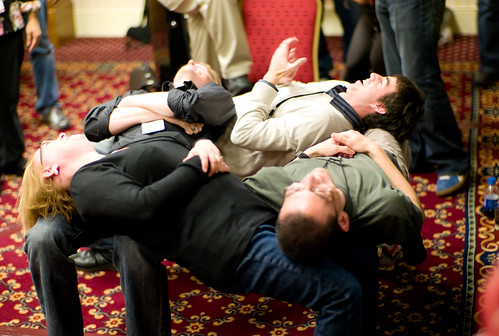
Social Media Surgery in Birmingham, from HNM_1977 on Flickr

Social Media Surgery in Birmingham, from HNM_1977 on Flickr

So what happened last time?  Well, Paul Henderson took the photo above whilst Chris Ivens summed up the point of the surgeries rather neatly:

Q: What is a Social Media Surgery?  A: With an abundance of buzz-words at every tick and turn and an almost daily mention of twitter in the news we try to look at what technologies could really help your organisation and we’re here to explain in plain English what they are. It’s not a sales pitch nor are you obliged to do anything after the meet, I guess it’s the old cliché; ‘Giving Something Back’. If you come and find the session useful, please pass on the word so more people can benefit.

As with most of our surgeries, people went away having set up new blogs or picked up tips about how else they can use the social web to help their project, programme, campaign or neighbourhood.

Cannon Hill People’s Park came along for the second time. Tony Fox said of his first surgery:

Thanks to the brilliant advice and support we got last time it inspired us to put our Net.website up (just), and we’ll be along to discuss building on our Social support!

Tony and his team have now begun making good use of google maps.  Karen and Geoff Caine are the first people who’ve made the move from patient to surgeon, having now made good use of their newish blog for the City Centre Neighbourhood Forum, explored with google maps and begun to encourage people to use services such as the excellent fixmystreet.

It was a good evening for neighbourhood groups.  Ged Hughes of the Acocks Green Neighbourhood Forum came along, her first time at a surgery. She left saying she would love to come again and the following day created a blog for the forum. (Hurrah!).  The first post tells us that their AGM is on May 14th, the day after the next social media surgery. It also pointed me to another local group already using social media, the Acocks Green Focus Group.

Other neighbourhood interest came from the East Yardley Neighbourhood Forum who went away with a head crammed full of ideas and established this starting point for conquering the social web world. Also John Heaven was with us looking for help on how to build on what is already being achieved at Lozells.info.

Laura Creaven  of LUCIA Charity set up this personal blog and has got off to a roaring start. Her take on the surgery:

I have to say it was a fascinating meeting and I’m really glad I went. I’m all a bit keen about what we could achieve with it. So I’m a little excited about going to work tomorrow – sad isn’t it?!

Also with us was Mary from Birmingham Friends of the Earth and Attiya from the Health Exchange who left having set up an experimental personal blog.

The ever brilliant all-volunteer surgeons were Ben WaddingtonNicky Getgood, Chris Ivens, Pete Ashton, Paul Henderson, Gavin Wray, Daniel Davis, Simon WhitehouseNeil Houston – who blogs about food – joined us for his first session and Rob Annable gave some great help on open source mapping. I love the way the people who help at the surgeries vary from month to month, so endless thanks for their help and a particular thank you to Diane from Fazeley Studios who also volunteers her time to keep the place open.   I always forget at least one person when I list these, so apologies in advance and please just tell me and I’ll put it right.

“Can we talk” – a new measure for liveable cities.

Tuesday, March 31st, 2009

I’ve been asked by MADE to write 200 words for the Birmingham Post. They’re gauging opinion before the Technical and Environmental  Mayor of Copenhagen speaks in Birmingham next week. Klaus Bondam will be at Town Hall on April 6th to share with us how he expects Copenhagen to stays a wonderful place to live.

I was asked about an hour ago and the deadline is tonight.  Here’s a bashed out draft of what I fancy saying. Please encourage, discourage amend etc in the comments. Does anyone have details of that survey that put us the 2nd best place for social media behind, is it Chicago?

————————————————————————–

Is this a good place to talk?  It’s not a question we often ask about cities.  After all the whole point of a city is that we can connect, trade and work.  Non of that happens without talk, does it? No it doesn’t, and neither does innovation.

Conversation is about scale, it happens where it’s easy for people to gather in small groups.  The ICC is evidence that we know about audience on a grand scale, but how well do we do small scale gathering?

We need many places where we can meet, deliberately or by accident.  That means a city which is easy to walking but above all has many interesting and modestly scaled places that people want to go.   It means a tolerance of other’s ideas and interests, a city where people also like to listen.

These are partly planning issues and partly cultural issues. How good are our public services at setting the example and being interested in us, how good our our planners and designers at encouraging the interesting?

And of course we don’t just want to talk to ourselves. Birmingham needs take part in a global conversation.  So our schools need open access to the internet and our school teachers and pupils helped to have the confidence to take part in sharing and developing ideas with people across the planet.

Oh and Birmingham doesn’t have free internet access in the city centre, whatever our PR folk may so. So Birmingham Fizz needs to be turned of or turned into a proper free wifi service, so we can finally start hearing each other speak.

Well?

Social Media and Social Housing

Monday, November 17th, 2008

Trust from Joi on Flickr - click image to see the original.

This afternoon I spoke at the National Housing and Disrepair Forum annual conference. 100 or so council officers, solicitors, barristers, housing association types and others worrying about just how much money is spent on compensating council tenants for repairs that haven’t been done. This is a link to the presentation:  Talk is cheap – so use it more.

I was invited by Kate Priest, the head of the legal department at Birmingham City Council that deals with such matters.  Kate had heard me talking about local government, social media and the changing democratic relationship in one of my sessions at the Institute of Local Government.

A £3,000 pound compensation bill for a tenant could mean a £15,000 bill from their lawyers – and all that comes out of the repairs budget. So it’s worth exploring other ways to stop this.

I wanted to get across the idea that this can be thought of as a problem of trust. Lawyers thrive where trust does not.  The challenge I wanted to throw to the group was how can they understand this as more than a problem of record keeping, accountability and process? Instead can they involve their people in sincere networks of trust within neighbourhoods.
The presentation is simply designed to offer examples of how and where the social web builds real networks of trust – ones which can make things happen. It was intended to give them a sense that trust is worth hard cash. The tenant who trusts their council worker and so negotiates directly with them could free up thousands for work of public value.  The tenants who are part of a wider network of trust may even be able to help negotiate priorities.

Thank you for a big chunk of input on twitter (image here and here of the 19 comments). Here is what you suggested:

By presenting an authentic face to tenants which listens and responds to their concerns and issues and by helping to link tenants up to find others in their situation, or who have resolved issues to share experience and connect”  Dave Briggs.

Listen to people where they are already talking about you (good and bad stuff)” Paul Henderson.

“Any way of improving two-way communication must surely help”  Catnip.

Councils need to improve / review their relationships offline before making a difference online”  Stuart Parker.

One easy win would be for blogs to be set up for individual estates – the council can keep tenants fully in the loop of developments, the tenants would be able to have their say, but also that blog could help develop & bind the community of the estate itself together. wins all round, for minimal financial investment, really.”  Simon Gray.

Not a council tenant, but as a private one an answerphone and email address would be a start!” and “I think the question’s wrong: maybe, ‘what are the problems facing council tenants’ and keep soc media in mind when addressing them “  Michael Grimes.

“This is helping in some respects, esp with young people on 1st tenancy http://www.inliving.co.ukJohn Popham.

If social media is ‘informal’ it will help get over the “stigma” of phoning somone or appearing in person.” Paul Jennings

Human face and interaction with two-way content. Would also bring tenants into contact with each other as well as council.” Nicky Getgood.

I think councils are way off social media. Difficult to control comms leads to degraded service. Also privacy issues and challenge of delivering service using tools and channels that are external. Eg what if Twitter down? Ian Edwards.

Google alerts for blog posts about “dog sh*t” or “broken paving slab” + their ward, then follow it up. That’s only a semi joke”.  Jon Hickman.

Blogging for different estates. Would get people to know each other and get them talking about issues that matter to them.”  Antonio Roberts

Works t’other way- CLG wants tenants 2 have a role in mgmt- better way 2 engage than endless meetings (although meetings r useful)”.  Nick Drew

Toronto based Michael Cayley also asked: “ pls share some references used for trust & social capital session aimed at lawyers who defend councils from housing repair claims. 

I used very simple examples. I was facing an audience of 100 people, none of whom blog, only one had heard of twitter.  Even though I was amongst many lawyers only a smattering had come across Linkedin.   I needed to show how building networks of trust can help make good things happen.  I used the example of the Birmingham Bloggers group and the Social Media Surgeries. I used the volunteer effort that mysociety can apply to ventures like  fixmystreet (and not a soul in the room  had heard of the site). I also talked to them about the open innovation exchange experiment and how it’s model of open collaboration to pitch for contracts is using trust to disrupt existing ways of doing business and improve the outcome for the public.

Responses were mixed.  Some went for the very human (my favourites) such as getting good at saying sorry, takings flowers when you’ve messed up and having street meeting with contractors. Others talked specifically about  procedures and software to track transactions.  One reported how law firms use facebook to recruit people for court cases.

Overall I tried to emphasise that I wanted people to go away not so much thinking about the internet, but appreciating that whatever they can do to build trust should ultimately reduce their need to fight fruitless court battles with the very people they exist to help.

We’ll see what comes next.

Who’s coming to the Birmingham Social Media Surgery, BAD08

Monday, October 13th, 2008
Pete Ashton stumbles across a 'shelter' for homeless people in Birmingham

I thought is was time to take stock, not least to ensure sufficient tea and coffee for the social media surgery which us Birmingham bloggy folk are organising (with BVSC) to support voluntary and community groups in the city on Blog Action Day.

If you want to know how social media can help you campaign, garner support, raise funds, change the world then please sign up through this link (Wednesday, October 15th 2008, BVSC (map) 5.30pm to 7.30 pm). Come when you can for some free, friendly, one to one support.

Sign up here:

http://birminghamblogactionday2008.eventbrite.com/

The Social Media Surgeons:

Coming from Somerset we have Steve Bridger, once of The Guardian website and Oxfam now a specialist in online fund raising and community management. I first met Steve through shared involvement with the NCVO ICT Foresight project.  Also getting here by train, this time from Sheffield, is Paul Webster. I think I first met Paul at the UKGOVBarcamp.   Paul travels endlessly, bringing vol orgs and their suport organisations up to speed with how IT and the web can help them.

Stef Lewandowksi will be there, sharing his enormous experience of producing blog based websites which achieve things, from webby award winning sites to those that build networks around curious human ideas, Stef builds some of the most elegant pages you can find on the web. He’s also offering:

half a day of my time to produce from scratch a blog-based website for one charitable organisation that works with disadvantaged or at risk kids, at no charge.

This is a brilliant offer. Stef can achieve a great deal in half a day if he’s working with an organisation that’s keen to get on with things.

Pete Ashton – who’s the first person I know to come up with the idea of a social media surgery – will also be there to help. One of the countries first professional bloggers, Pete has won national awards and helped the cities creative community burst into online collaboration and conversation through establishing Created in Birmingham. That leads me on  to another local. Chris Unitt has run Created in Birmingham for the last 6 months or so and is a very talented blogger who’s also applied his professional energies to initiatives such as cQuestrate, an ambitious project to develop an open source solution to climate change.

Others possibly/hopefully coming who can help with everything from how to set up a blog to how to run a festival (should that help reduce poverty) are Anthony Herron, Dave Briggs, Nicky Getgood and Antonio Roberts. (Update:  Joanna Geary – a Birmingham Post journalist who’s helping introduce social media to newspapers, is also hoping to come).
I (Nick Booth) will also be there with my background in BBC journalism then community podcasting and various work with local government, schools and community groups on using social media as a tool for empowerment.

Jon Bounds and Julia Gilbert, both of whom have energetically inspired and worked on this idea, can’t make Wednesday, but just thought I’d day hello and thank you.

Social Media Patients(!?):

So far I’ve had about 15 people say they’re hoping to come from various groups, some with url, some without names!  Among them are Gerry Moynihan of the Bordesley Green Neighbourhood Forum. I’ve worked with Gerry before to make this film and podcast for a European wide group of active citizens called R4R.  I spoke to Claire Rigby of Fairbridge earlier this week and if she can’t make it she means to encourage someone else to com along.  Her charity supports young people to pull themselves out of destructive patterns, often involving drugs.
Stuart Parker is establishing a social enterprise to use the power of the social web to help people who foundered in education. I’m sure he’ll be teaching and learning.
Ally Sultana works with women in Balsall Heath and has been developing a podcast project – she’s already explored some social mediaAudrey Miller helped create the Jubilee Debt campaign which put so much pressure on the 1998 Birmingham G8 to cancel debt to Africa. Serena Malone works with Rural net, and again is someone who may be able to teach as much as she learns.

Then there’s Gary Smith from firstlightmedia and also working with young people, Colin Kerrigan of the charity Stage 2Stephen Brook is coming along from another educational charity excell3.

Linda Hines from the Witton Lodge Community Association in Perry Common is coming. She’s also a community champion for Be Birmingham (I recently worked with Be Birmingham on simple podcasts and material for their youtube channel and flickr.)  Other community champions might join us, as might community groups who’ve worked with Groundwork in Birmingham and members of the Third Sector Assembly.

If you’re coming and I haven’t mentioned you please use the comments section to say hello. For some that will be familiar – for others commenting on this blog post might be your first step in social media!—

—–

Update. Beside the bloggers some key organisations have also offerred their support with links and publicity, including Digital BirminghamBVSC who’s providing us with space and drinks and NAVCA.