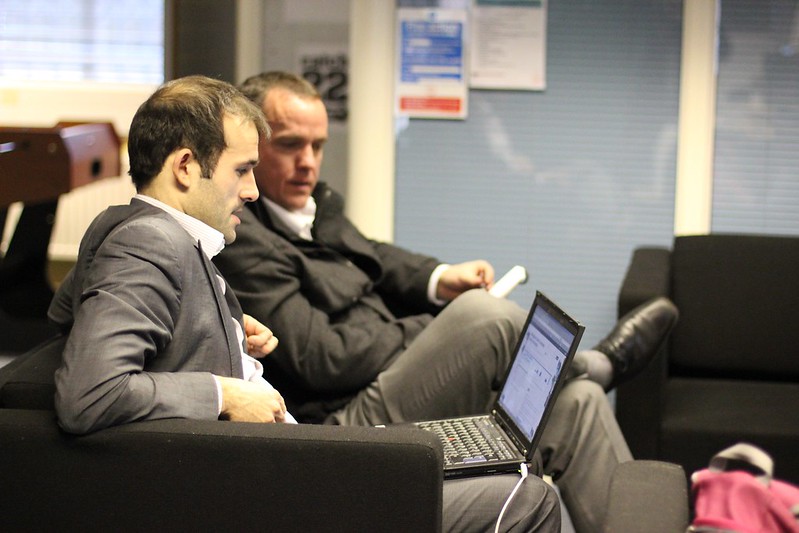
Over the last 2 days the Podnosh team hosted 24 science communicators from across Europe. They were in Birmingham as part of the Open Places project which is looking at bringing together 69 science communication institutions and other stakeholders in European cities to partner with local policy makers to tackle socio-economic issues such as employment; education; climate change and poverty from a scientific perspective.We met with them to discuss social media and the ways in which it can be useful to them in their workplaces or on this and other specific projects.
It was a lot to digest in 2 days but everyone seemed really enthused by what they had learned so in the final session we asked them to take a few minutes and write about what they felt they would take away with them from the sessions – what had really stood out for them;
Claire Hopkins from Aston University really took on board Nicks talk on social capital noting ”Not everything we put out into the world of social media needs to be heavyweight stuff. Just engaging with people – on anything – is important as it opens a conversation and starts to build trust within networks.” , as did Karen Gemal a project manager from th Danish Sciene Communication she quoted Nick saying “The loop of generosity generates social capital” and that her first steps will be to “get in the habit of following bloggers and tweets, rss-feeds and get familiar with the universe.”
You can find links to all the sites that were set up by attendees along with other posts and sites we discussed in our delicious stack videos from the event on both our channel and the Science Places channel on Youtube, photos over on Flickr and see what others were saying by looking up the #sciplaces tag on Twitter.
This post summarises emails I’ve sent in response to enquiries about the Central Birmingham Social Media Surgery I coordinate – and advice to other Surgery Managers.
It’s about my personal take on what – and specifically who – the surgeries are for. It also stems from feeling protective of the helpers who volunteer their time and skills for free at the surgery, the very social capital that makes the surgery work.
Dudley Social Media Surgery (image from Gavin Wray)
This was the question Beatrice asked me. She wasn’t sure if she could help as a surgeon at one of these events designed to support local community and voluntary organisations in a relaxed one to one format:
I would like to make myself useful helping other people and I would like to know what skills I would need to be a good social media surgeon.
I am not a technical person by background. I have, however, spent a fair amount of time on the internet and it would be good to know what skills would be in demand at such an event.
It seems I have a bit of time to mug up on skills before the event but I’d be grateful for any advice on where to focus. Twitter is my platform of choice. I have just splashed out on a camcorder and digital recorder but I doubt I will feel confident with these tools before the event. Can I still be a useful person if I stick to Twitter/Facebook/general internet skills?
Oh yes – very. The fact that Beatrice wants to help is really the most important skill/thing she needs – but I also replied with:
Ability to ask simple questions like “what are you trying to achieve” or perhaps “how do you use the web at the moment”
Willingness to listen to the answers
Enough knowledge/experience of say twitter or blogging or facebook to be a couple of steps ahead of the person you’re helping.
Patience, willingness to ask for help from another surgeon if they ask you something you can’t answer (including ability to google to answer questions you can’t answer)
Ideally a laptop or similar so you can show people how the social web works in your experience.
That’s about it really! A sense of fun helps too (see the pic above of “surgeon” and “patient” in Dudley)
I have been helping at a couple of surgeries now including the well established Central Birmingham Surgery and the Wolverhampton Surgery which I helped to get started and each one is different.
Lozells and Birchfield surgery is small and whilst the Central Birmingham surgery is run through podnosh on a voluntary basis this one forms part of our paid work.
Today I returned to Lozells Methodist Church to help the surgery manager Jo Burrill from our client Midland Heart – a social housing organisation who work hard in communities, and 4 patients who’d registered for today. Selwyn looking for support with his email, Chris and Kevin both with WordPress enquires and Verona who wanted some help posting to a website. It was a nice number and while I helped Chris with his stuff and Jo helped Verona with hers the others got chatting and Kevin turned into an impromptu surgeon to help support Selwyn with his email problems – every one left happy having received the help they needed.
Everyone who has attended each of these surgeries either surgeon or patient has left satisfied with their input and that is is the measure of their success, it’s not the number of people that come through the door but being able to help the people that are there. So while in comparison to the to the city centre surgeries of Birmingham and Wolverhampton, Lozells and Birchfield’s Neighbourhood Surgery is small but it’s definitely perfectly formed.
Social media surgeries in the UK received lots of attention last Thursday when the Prime Minister recognised the social media surgery movement with a Big Society Award for 2012.
Nick posted about the award and mentioned the wonderful people who have organised surgeries over the last three years in the UK. They’re enthusiastic, generous people who make stuff happen.
While the Big Society Awards acknowledge individuals and organisations across the UK that demonstrate the Big Society in their work or activities, I thought I should mention the surgeries outside the UK. It’s great to see an idea that originated in Birmingham spread to other shores – and I’m keen to hear how the surgeries are working in other countries.
Here are the wonderful people who have taken the social media surgery model abroad and run their own events:
The Big Society Awards were set up by the Prime Minister in November 2010 to acknowledge individuals and organisations across the UK that demonstrate the Big Society in their work or activities. The aim is also to galvanise others to follow. David Cameron said this about the surgeries:
“This is an excellent initiative – such a simple idea and yet so effective. The popularity of these surgeries and the fact that they have inspired so many others across the country to follow in their footsteps, is testament to its brilliance.
“Congratulations to Nick and all the volunteers who have shared their time and expertise to help so many local groups make the most of the internet to support their community. A great example of the Big Society in action.”
Thank you for such kind words – to which we responded formally with:
“It’s wonderful to have recognition for everyone who has organised a social media surgery or turned up to volunteer their help. I think the surgeries work because they are simple. They are very easy to organise, fun to do and not in the least bit intimidating for people who want some help. They give active citizens and community groups the confidence and skills to use social media to campaign, organise and hold power to account. They’ve grown because of the passion and energy of bloggers and voluntary groups up and down the country.”
Background
The idea of a social media surgery originated with Pete Ashton – who used them with people who were looking for free help from his consultancy supporting arts organisations. We then applied the relaxed approach in a new way, scaling it up and putting together two sets of people – lovely helpers from the Birmingham Bloggers group (started in 2007) with the fab active citizens I’d had met through (more…)
Last Friday, Steph and I spent a great morning in Bexley at Orbit South housing association, with Orbit residents from Kent and Sussex.
We worked with Heather, Paula, Peter, Sue and Jackie to set up their own Posterous blogs to talk about what’s going on in their neighbourhoods and to help them in their roles representing Orbit residents where they live.
This week I’ve been playing with stacks on Delicious, the social bookmarking site. Stacks are a way to organise your links into a common theme and the new social features make collaborating much easier.
To learn how the new features work – rather than curate links around an arbitrary theme (such as “most awesome kitten stunt videos”, which someone has probably done already) – I started this stack to share resources and links aimed at social media surgery managers.
Yesterday at the Lozells and Birchfield Social Media Surgery I was paired with a young man who was looking for help setting up a blog for an organisation he was involved with. I started as always by chatting with him a little bit about what the work he was doing and what they wanted to use the blog for when he said something that really pulled what he was trying to achieve into focus for me;
“The girls have babies and the boys shoot and stab each other. I’ve lost count of the amount of christenings and funerals I’ve been to but I’ve never been to a wedding that’s just not what we do”
- He was talking about life in Handsworth and Lozells as he knew it.
The patients name was Mosies, he is a 19 year old ex gang member from Handsworth, He’s not long been found not guilty on a very serious criminal charge, and by his own admittance has been in trouble with the law before, and now he’s taking that experience to not only try and turn his life around but also to try and change the gang culture that plagues youths in some parts of North Birmingham.
He along with other ex gang members from opposing groups in the area, some with criminal records for gang related activities have come together to form the New Day Foundation, They are aiming to try and combat gang culture targeting younger children to educate them on the realities of gang life and try to show them that there are other options to what they think is “normal”, to change their futures so they can go to more wedding than funerals in their lives!
I sat for an hour and listened to Mosies as he told us about the path he’d taken to be sitting in the room with us that day. Where he’d come from, why he wanted to change the lives of people stuck with the perception that joining a gang was the only option and how he and the other members of his group hoped to do that.
He had the whole room enthralled and as he was telling us how at the age of 14 he stopped going out to the cinema with his friends so he could save his money to buy a gun and all I was thinking was look at you now! 5 years later a changed individual talking about the pride taken in earning money the “proper way”, looking forward to getting a mortgage and hoping the story of your experiences would in some way stop others having to go through it.
- and that right there is what I like so much about the Social Media Surgery format; Only in a room where people are encouraged to talk to each other and help each other one on one would I have heard Mosies story. At a prescribed training session we’d have all sat in rows listening to one person talking and hoping to pick up the most relevant bits for our needs and no one would have realised the momentous journey this one young man had taken to be there with us.
Last week I talked to the Ma Social Media Students at Birmingham City University about social media surgeries for community and voluntary organisations. I was explaining how they emerged from a wide range of activity that was building social capital here in Birmingham.
It’s a story I’ve told before but never really in such a concentrated way – in fact I told it twice in one day. The students were a guinea pig for the talk I was planning to give at Michael Overduin’sScience Capital event on “Networks, Nodes and Knowledge: from local enterprise to global engagement”.
The slides are here but what I’d like to share if what one of Dave Harte’s students made from the talk. Dave shared the whole thing with his overseas students who study the degree remotely. He asked them to:
This week I would like the distance learning students to reflect on the talk by Nick Booth and consider how you might go about setting up a social media surgery in your own town. What would your strategy be? Have a read of Nick Booth’s ‘recipe’ listas a starting point.
Your response should be a short (5-10 mins) video that tells us the following:
What’s your town like? – rich? poor? digitally deprived??
Is there a way to connect to voluntary groups and community organisations (an umbrella organisation of some sort)?
How would you go about connecting to other digitally minded folk to persuade them to help set up a surgery?
What’s stopping you doing this?”
This is a question about social capital and innovation, where is it, how does it happen. Can you nurture or grow both. Dave highlighted one response from Jeff Sage.
Jeff talked about how a group in London Ontario developed “Emerging Leaders” a network for connecting people. As yu can see they also work with different agencies in the city to help improve their community. Principles that struck a chord with the social media surgery ethos include:
never duplicate efforst of others or create silos and making mistakes should be a goal, rather than something you’re tryng to avoid.